Losing all or most of your teeth once meant a lifetime of removable dentures, adhesive pastes, and the constant anxiety of slipping prosthetics during meals and conversation. All-on-4 dental implants have fundamentally rewritten that story. By placing just four strategically positioned titanium implants per arch, this protocol delivers a complete set of fixed, non-removable teeth that look, feel, and function like the natural dentition you lost.
Developed and refined over two decades of clinical research, the All-on-4 concept has become the gold standard for full-arch rehabilitation worldwide, offering patients a permanent solution that restores not just chewing and speech but the confidence to smile without hesitation. This guide explains exactly how the treatment works, what sets it apart from conventional implants, what to expect during recovery, and how to choose the right prosthetic material for your new smile.
What Is the All-on-4 Treatment Concept?
The All-on-4 treatment concept is a full-arch implant protocol that uses four titanium implants to support a complete bridge of 10 to 14 teeth in a single jaw. The concept was pioneered by Portuguese implantologist Dr. Paulo Maló in the late 1990s and has since accumulated over 20 years of peer-reviewed clinical evidence supporting its safety, predictability, and long-term success. The International Journal of Oral & Maxillofacial Implants has published multiple longitudinal studies documenting cumulative survival rates exceeding 95 percent for All-on-4 restorations at 10-year follow-up, placing it among the most well-documented protocols in implant dentistry.
The defining innovation of All-on-4 lies in the angulation of the posterior implants. While the two anterior implants are placed vertically in the front of the jaw where bone is naturally thickest, the two posterior implants are tilted at 30 to 45 degrees.
This angulation achieves three critical objectives simultaneously: it maximizes contact with available bone by engaging a longer path through the jawbone, it bypasses anatomical obstacles such as the maxillary sinus in the upper jaw and the inferior alveolar nerve in the lower jaw, and it increases the anterior-posterior spread of the implant platform, which dramatically improves the biomechanical support for the cantilevered posterior section of the bridge.
The result is a protocol that can rehabilitate a fully edentulous arch with just four implants, often without the need for bone grafting procedures that add months of healing time and thousands of dollars to the treatment cost.
How It Differs from Traditional Implants
Understanding the difference between All-on-4 and conventional implant approaches is essential for making an informed treatment decision. Traditional full-arch implant rehabilitation typically involves placing six to eight vertically oriented implants per arch, each positioned independently to support individual crowns or short-span bridges.
This approach requires sufficient bone volume at every implant site, which frequently necessitates bone grafting, sinus augmentation, or ridge augmentation procedures before implant placement can even begin. The grafting adds a separate surgical phase, a healing period of four to nine months, and significant additional cost.
All-on-4 eliminates or drastically reduces the need for grafting by using the existing bone more intelligently. The tilted posterior implants engage the dense cortical bone of the anterior sinus wall or the anterior mental region, areas that are naturally resistant to resorption even in patients who have been edentulous for years. This means that patients who have been told they “don’t have enough bone for implants” under conventional protocols are often excellent candidates for All-on-4.
| Feature | All-on-4 | Traditional Full-Arch Implants |
| Number of implants per arch | 4 | 6 – 8 |
| Bone grafting required | Rarely | Frequently |
| Immediate teeth (same day) | Yes, in most cases | Rarely (delayed loading typical) |
| Total treatment time | 3 – 6 months (two visits) | 9 – 18 months (multiple phases) |
| Number of surgeries | 1 | 2 – 3 (grafting + implant + prosthesis) |
| Relative cost | Lower | Higher |
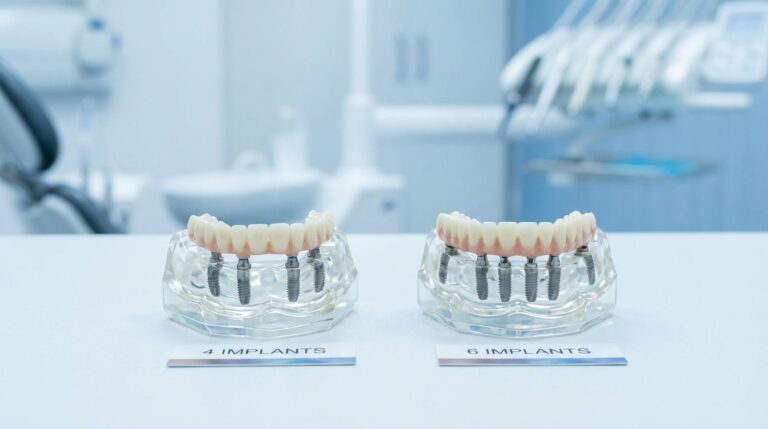
The clinical efficiency of All-on-4 translates directly into reduced surgical trauma, shorter overall treatment time, fewer appointments, and lower total cost, all without compromising long-term outcomes. For patients who want to compare the additional stability offered by six implants, the All on 6 protocol provides an alternative with two extra support points per arch, which is particularly beneficial in cases with reduced bone density or patients with heavy bite forces.
The All-on-4 Implants Procedure
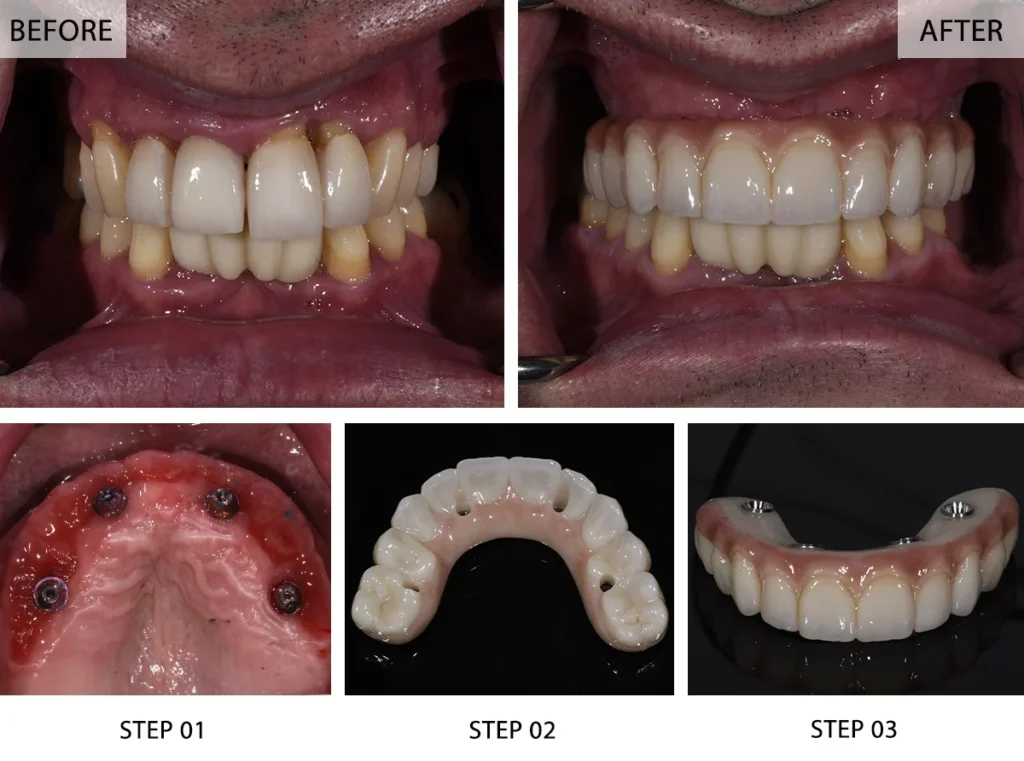
The All-on-4 procedure follows a meticulously planned sequence that transforms a patient from edentulous or failing dentition to a fixed, functional set of teeth, often within a single day of surgery.
3D Imaging & Digital Design
Every All-on-4 case begins with complete three-dimensional imaging. A cone beam computed tomography (CBCT) scan creates a detailed volumetric map of the jawbone, revealing bone density, bone height and width at every potential implant site, the precise location of the maxillary sinuses and inferior alveolar nerves, and any pathology such as residual cysts or infections that must be addressed before surgery.
This CBCT data is imported into implant planning software where the surgeon virtually places each of the four implants in the optimal position, angle, and depth. The software calculates the anterior-posterior spread, verifies that adequate bone engagement is achieved, and confirms that no anatomical structures are compromised. Once the virtual plan is finalized, a surgical guide, a 3D-printed template that fits over the jawbone and directs the drill precisely into the planned positions, is fabricated. This guided surgery approach transforms the procedure from a freehand operation into a precision-engineered placement, dramatically increasing accuracy and reducing surgical time. Simultaneously, the prosthetic team designs the provisional bridge based on the planned implant positions, ensuring that a complete set of teeth is ready to attach to the implants on the day of surgery.
Surgical Placement & “Teeth in a Day”
On surgery day, the procedure is typically performed under local anesthesia with intravenous sedation, though general anesthesia is available for patients who prefer complete unconsciousness. Any remaining teeth are extracted, the implant sites are prepared through the surgical guide using a sequential drilling protocol, and the four titanium implant fixtures are placed into the jawbone. The surgeon verifies that each implant achieves adequate primary stability, measured in torque values using an insertion torque wrench, to support immediate loading.
Once all four implants are confirmed stable, abutments (connector pieces) are attached, and the pre-fabricated provisional bridge is secured to the implants. The patient leaves the clinic on the same day with a full arch of fixed, non-removable teeth. This “teeth in a day” protocol is one of the most compelling advantages of All-on-4: patients arrive with failing or missing teeth and walk out hours later with a functional, aesthetic smile. The provisional bridge is designed for the healing period and allows the patient to eat, speak, and smile normally while the implants integrate with the bone beneath.
The Osseointegration Period
Over the following three to six months, the titanium implants undergo osseointegration, the biological process in which living bone cells grow directly onto the micro-textured implant surface, creating a permanent, load-bearing bond. During this period, the provisional bridge remains in place and functional, but the patient follows a modified diet that avoids excessive force on the implants. The lower jaw typically integrates faster, in three to four months, due to denser cortical bone, while the upper jaw may require four to six months due to softer trabecular bone.
The integration process is monitored through clinical assessment and follow-up radiographs. Once the surgeon confirms complete osseointegration, the provisional bridge is removed and replaced with the definitive prosthesis, the permanent bridge that will serve the patient for the next 15 to 20 years or longer. This transition from provisional to definitive restoration is typically completed during a second visit lasting three to five days.
Recovery & The Roadmap to a Normal Diet
Recovery from All-on-4 surgery follows a predictable timeline that patients should understand in advance to set realistic expectations and optimize healing outcomes.
The first 48 to 72 hours represent the acute recovery phase. Swelling peaks around day two to three and is managed with cold compresses (15 minutes on, 15 minutes off) and prescribed anti-inflammatory medication. Bruising of the cheeks and jawline is normal and resolves within seven to ten days. Pain is typically moderate and well-controlled with prescribed analgesics; most patients report that the discomfort is less severe than they anticipated. Bleeding from the surgical sites is minimal after the first few hours, and patients are instructed to avoid spitting, using straws, or rinsing vigorously during this period to protect the blood clots forming around the implants.
The dietary progression follows a structured roadmap:
- Days 1 – 14: Liquid and very soft foods only — smoothies, protein shakes, pureed soups, yogurt, mashed potatoes, scrambled eggs
- Weeks 3 – 6: Soft foods requiring minimal chewing — pasta, soft bread, cooked vegetables, soft fish, ground meat
- Weeks 7 – 12: Gradually introducing firmer foods — grilled chicken, steamed vegetables, soft fruits
- After definitive prosthesis delivery: Full diet including most foods, with continued caution around very hard items such as ice, whole nuts, and bone
The transition from provisional to definitive bridge marks the return to a fully unrestricted diet for most patients. The definitive prosthesis is stronger, thinner, and more precisely fitted than the provisional, allowing patients to enjoy foods they may not have eaten comfortably for years. Biting directly into very hard objects remains inadvisable regardless of the prosthesis type, a precaution that applies equally to natural teeth, Emax Veneers, Dental Crowns, and any prosthetic restoration.
All-on-4 Implant Types
The choice of prosthetic material for the All-on-4 bridge directly affects its aesthetics, durability, weight, repairability, and cost. Two primary options dominate the market in 2026, each with distinct advantages.
Acrylic (Hybrid) Bridges
The acrylic hybrid bridge consists of a milled titanium framework overlaid with individual acrylic resin teeth and a gum-colored acrylic base. This design has been the traditional standard for All-on-4 restorations for many years and remains widely used.
The advantages of acrylic hybrid bridges include lower cost compared to full zirconia, lighter weight which some patients find more comfortable during the initial adjustment period, easier chairside repairability if an individual tooth chips or fractures, and a softer material that produces a more natural “feel” during chewing. The disadvantages include a shorter lifespan of approximately 8 to 12 years before replacement is needed, susceptibility to staining from coffee, tea, and tobacco over time, gradual wear of the acrylic teeth under heavy chewing forces, and a slightly bulkier profile compared to zirconia due to the need for sufficient material thickness to house the titanium framework.
Monolithic Zirconia Bridges
Monolithic zirconia bridges are milled from a single block of high-strength zirconia using CAD/CAM technology, producing a prosthesis that is extraordinarily strong, stain-resistant, and aesthetically refined.
With a flexural strength of 900 to 1200 MPa, monolithic zirconia is virtually fracture-proof under normal and even heavy functional loads. Its surface is non-porous, meaning it resists stain absorption from food, beverages, and tobacco far more effectively than acrylic. The latest generation of high-translucency zirconia materials have closed the aesthetic gap with acrylic significantly, offering natural-looking shade gradients and gum-colored characterizations when designed by a skilled ceramist. The lifespan of a monolithic zirconia All-on-4 bridge is 15 to 20 years or longer, roughly double that of an acrylic hybrid.
| Property | Acrylic Hybrid | Monolithic Zirconia |
| Framework | Milled titanium | Full zirconia (monolithic) |
| Flexural strength | Moderate | Very high (900–1200 MPa) |
| Average lifespan | 8 – 12 years | 15 – 20+ years |
| Stain resistance | Moderate (stains over time) | Excellent (non-porous surface) |
| Repairability | Easy chairside repair | Difficult (requires lab) |
| Weight | Moderate | Light |
| Relative cost | Lower | Higher |
The choice between acrylic and zirconia should be discussed with your prosthodontist based on your budget, aesthetic expectations, bite force profile, and long-term maintenance preferences. Many patients opt for an acrylic provisional during the healing phase and upgrade to a definitive monolithic zirconia bridge once osseointegration is confirmed. This staged approach provides immediate function at a lower initial cost while delivering premium longevity in the final restoration. For patients interested in the aesthetic possibilities of different dental ceramics, our Emax Veneers and Dental Crowns treatment pages provide detailed comparisons of material options for individual tooth restorations.

FAQ
How long do All-on-4 dental implants last?
The All-on-4 implant fixtures themselves, the titanium screws embedded in the jawbone, can last a lifetime with proper care. Clinical studies with follow-up periods exceeding 15 years report cumulative survival rates above 95 percent. The prosthetic bridge attached to the implants has a finite lifespan that depends on the material: acrylic hybrid bridges typically last 8 to 12 years, while monolithic zirconia bridges can function for 15 to 20 years or longer before replacement becomes necessary. Regular professional maintenance, proper daily hygiene, and the use of a nightguard for patients with bruxism are the three factors that most reliably maximize the longevity of both the implants and the prosthesis.
Is the All-on-4 procedure painful?
The surgical procedure is performed under local anesthesia with intravenous sedation, so patients feel no pain during the operation. Most patients report that the post-operative discomfort is moderate, comparable to a tooth extraction, and well-managed with prescribed pain medication. Swelling and bruising are the most common post-surgical complaints and resolve within seven to ten days. Many patients express surprise at how manageable the recovery is, particularly given the scope of the procedure. For patients with significant dental anxiety, general anesthesia is available as an option at most clinics performing All-on-4 surgery.
What is the success rate of All-on-4?
The All-on-4 protocol has one of the most strong evidence bases in implant dentistry. Published clinical studies consistently report implant survival rates between 95 and 98 percent at 5 to 10 year follow-up, with prosthetic survival rates (the bridge remaining functional without major complication) in a similar range. The European Journal of Oral Implantology has published systematic reviews confirming these figures across multiple centers and patient populations. Factors that influence individual success include the patient’s overall health, smoking status, bone quality, oral hygiene compliance, and the experience of the surgical and prosthetic team.
Can I still get All-on-4 if I have bone loss?
This is one of the greatest advantages of the All-on-4 protocol. The tilted posterior implants are specifically designed to engage available bone in areas where vertical bone height may be insufficient for conventional vertical implants. Patients with moderate to significant bone loss who have been told they are “not candidates” for traditional implants are frequently excellent candidates for All-on-4. In cases of severe bone loss, the All on 6 protocol with two additional implants can provide extra support, or zygomatic implants, which anchor into the cheekbone rather than the jawbone, may be considered for the upper arch. A CBCT scan is the definitive tool for determining candidacy, and our team at Clean Smiley Turkey can evaluate your scan and provide a detailed treatment recommendation through the free quote process.
How do I clean my new All-on-4 teeth?
Daily hygiene for an All-on-4 prosthesis requires specific tools and techniques. Standard brushing with a soft-bristled toothbrush cleans the visible surfaces of the bridge effectively. The critical area is the interface between the underside of the bridge and the gum tissue, where food debris and plaque can accumulate. A water flosser is the most effective tool for flushing this zone, directing a pressurized stream of water beneath the bridge to dislodge particles and bacteria. Interdental brushes can access the spaces around the implant abutments where they emerge through the gum. Super floss, with its stiff threader end and spongy middle section, can be passed beneath the bridge for additional mechanical cleaning. Professional cleaning every six months is essential; the hygienist uses specialized instruments to clean around the implant abutments and beneath the prosthesis in areas that home care cannot fully reach. Consistent maintenance is the single most important factor in preventing peri-implant mucositis and peri-implantitis, the inflammatory conditions that threaten implant longevity.
Conclusion
All-on-4 dental implants have transformed the field of full-arch rehabilitation, offering a fixed, permanent, and functionally superior alternative to removable dentures. Four strategically angled implants provide the foundation for a complete set of teeth that restore chewing efficiency, speech clarity, facial structure, and the confidence to smile openly. The protocol’s ability to bypass bone grafting in most cases, deliver immediate teeth on the day of surgery, and achieve long-term success rates above 95 percent has made it the treatment of choice for hundreds of thousands of patients worldwide.
Whether you choose the accessibility of an acrylic hybrid bridge or the premium longevity of monolithic zirconia, the All-on-4 concept delivers a result that fundamentally changes how you eat, how you speak, and how you feel about yourself. Combined with proper daily hygiene and regular professional maintenance, your new smile can serve you for decades.
To discover whether All-on-4 is the right solution for your situation, or to compare it with the All on 6 protocol and other Dental Implant options, contact Clean Smiley Turkey. Our expert team in Antalya combines advanced 3D surgical planning with world-class prosthetic design, all within all-inclusive packages that include hotel accommodation and Mediterranean tours. Request your free quote today and take the first step toward a permanent, confident smile.