When your gum tissue recedes, it does not grow back on its own. The exposed root surface that remains is vulnerable to sensitivity, decay, aesthetic deterioration, and progressive bone loss that can ultimately threaten the survival of the tooth itself. Dental grafting gum treatment is the definitive solution; a surgical procedure that transplants tissue to the recession site, rebuilding the protective gum coverage that nature intended and halting the cascade of complications that untreated recession sets in motion.
Whether your recession was caused by aggressive brushing, periodontal disease, genetics, or a combination of factors, modern gum graft techniques can restore both the health and the appearance of your gum line with predictable, long-lasting results. This guide explains the types of gum grafts available, how the procedure is performed, what recovery looks like, what it costs, and how the latest minimally invasive techniques are changing the patient experience.

What Is a Gum Graft?
A gum graft, clinically known as a gingival graft or periodontal soft tissue graft, is a surgical procedure that adds new tissue to an area of the gum line where recession has exposed the root surface of one or more teeth. The transplanted tissue integrates with the existing gum, increasing the thickness and height of the attached gingiva, covering the exposed root, and re-establishing the protective seal between the tooth and the oral environment.
Gum recession exposes the cementum and dentin of the root, surfaces that are softer and more porous than enamel and were never designed to face the bacteria, acids, and mechanical forces of the oral cavity. Without the protective band of keratinized gingiva that normally surrounds each tooth, these exposed roots become hypersensitive to temperature and touch, highly susceptible to root caries (decay), and vulnerable to further recession as the thin, unattached tissue continues to migrate. The American Academy of Periodontology classifies gum grafting as one of the most effective and well-documented surgical procedures in periodontal therapy, with decades of clinical evidence supporting its long-term success in halting recession and restoring gingival coverage.
The goals of dental grafting gum treatment are threefold: to cover the exposed root and eliminate sensitivity, to increase the zone of attached keratinized tissue that resists further recession, and to restore the natural aesthetic contour of the gum line. When performed by an experienced periodontist, a successful graft achieves all three objectives simultaneously, protecting the tooth for the long term while creating a gum line that looks natural and frames the smile harmoniously.
The 3 Main Types of Gum Grafts
Not all gum grafts are the same. Three primary techniques exist, each sourcing tissue differently and suited to specific clinical situations. Your periodontist will recommend the approach that best matches the type and severity of your recession, the thickness of your existing tissue, and your aesthetic goals.
1. Connective Tissue Graft
The connective tissue graft (CTG) is the most widely performed and most clinically documented gum graft technique in periodontal surgery. Tissue is harvested from beneath the surface of the palate (the roof of the mouth) through a small flap incision. The harvested tissue consists of dense connective tissue without the surface epithelial layer, which gives it superior healing properties and excellent integration with the recipient site.
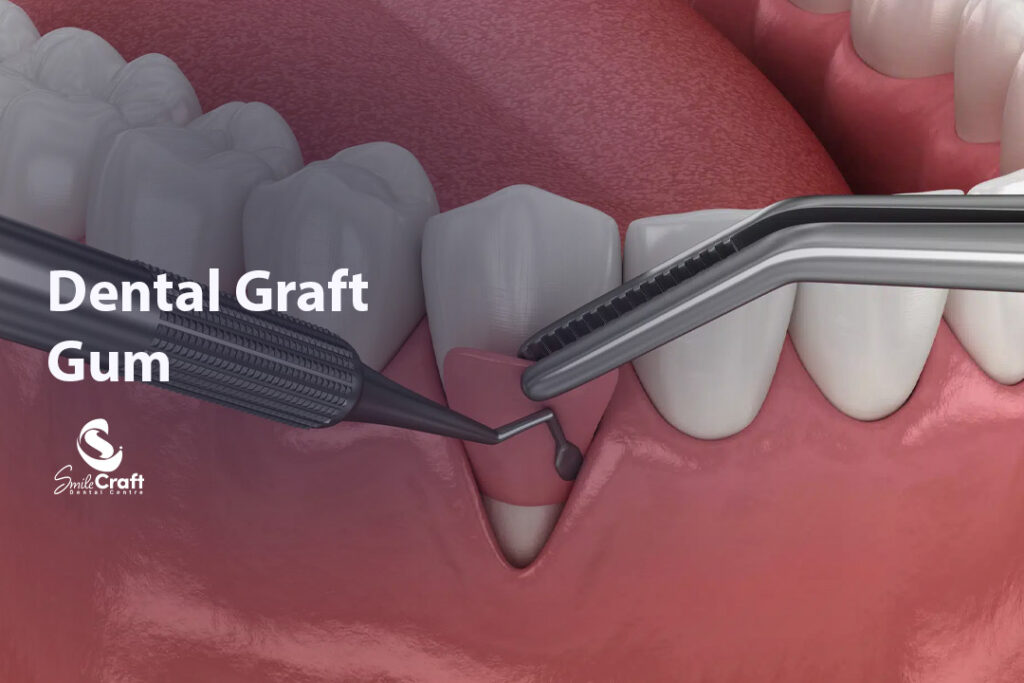
At the recession site, the periodontist creates a small envelope or tunnel in the existing gum tissue and slides the connective tissue graft beneath it, positioning the graft over the exposed root surface. The overlying gum tissue is then sutured over the graft, providing it with blood supply from both above and below.
This dual blood supply is the key to the CTG’s high success rate; the graft is nourished from both the underlying root surface and the covering tissue flap, maximizing the probability of complete integration and root coverage.
The CTG is considered the gold standard for root coverage procedures. A meta-analysis published in the Journal of Clinical Periodontology reported mean root coverage rates of 80 to 90 percent with connective tissue grafts, with complete (100 percent) root coverage achieved in approximately 50 to 80 percent of cases depending on the initial severity of recession and the classification of the defect. The technique produces excellent aesthetic results because the surface tissue covering the graft retains the color and texture of the surrounding gum, creating a smooth appearance.
2. Free Gingival Graft
The free gingival graft (FGG) harvests a thin strip of tissue directly from the surface of the palate, including the keratinized epithelial layer, and transfers it to the recession site where it is sutured directly onto the exposed root surface or adjacent to the receded area. Unlike the CTG, the graft is not tucked beneath existing tissue; it sits on top, exposed to the oral environment, and relies on blood supply from the underlying recipient bed alone.
The primary indication for a free gingival graft is not root coverage but rather the augmentation of keratinized tissue width. In areas where the gum tissue is thin, fragile, and lacks the dense keratinized band necessary to resist mechanical trauma from brushing and chewing, the FGG creates a strong band of attached tissue that prevents further recession. This technique is particularly valuable around Dental Implants where adequate keratinized tissue is essential for long-term peri-implant health, and on lower front teeth where the tissue is naturally thin and recession-prone.
The trade-off is aesthetics. Because the graft tissue comes from the palate, which has a different color and texture than the surrounding gum tissue, the free gingival graft can create a visible “patch” appearance that does not blend as seamlessly as a connective tissue graft. For posterior teeth or areas where function takes priority over appearance, this is rarely a concern. For anterior teeth in the smile zone, the connective tissue graft or allograft alternatives typically produce a more aesthetic outcome.
3. Allograft / AlloDerm (The “No-Cut” Option)
Allograft tissue, most commonly marketed under the brand name AlloDerm, is acellular dermal matrix derived from donated human tissue that has been processed to remove all cellular components while preserving the collagen scaffold. This processed matrix serves as a biological framework that the patient’s own cells infiltrate, vascularize, and remodel into functional gum tissue over the weeks following surgery.
The primary advantage of an allograft is that it eliminates the need for a palatal donor site entirely. There is no second surgical wound, no palatal pain, no risk of palatal bleeding or nerve damage, and no limitation on the amount of tissue that can be obtained. This makes allografts particularly appealing for patients who require grafting across multiple teeth or multiple quadrants, where harvesting sufficient autogenous tissue from the palate would be challenging or excessively traumatic.
The success rates for allografts, while good, are generally slightly lower than those for autogenous connective tissue grafts. Root coverage percentages with AlloDerm typically range from 65 to 85 percent in published literature, compared to 80 to 90 percent for CTG. The reduced predictability is attributed to the fact that allografts lack the living cells present in autogenous tissue, making them more dependent on the recipient site’s vascularity and healing capacity. For patients who prioritize minimizing surgical discomfort and avoiding a palatal wound, allografts represent an excellent compromise between efficacy and patient experience.
| Graft Type | Tissue Source | Root Coverage | Palatal Wound | Best For |
| Connective tissue graft (CTG) | Patient’s own palate (sub-epithelial) | 80 – 90% | Yes | Root coverage with optimal aesthetics |
| Free gingival graft (FGG) | Patient’s own palate (surface) | Limited (augments width) | Yes | Increasing keratinized tissue band |
| Allograft (AlloDerm) | Processed donor tissue | 65 – 85% | No | Multi-site grafting, patient comfort |
How Is Dental Grafting Gum Treatment Performed?
The dental grafting gum procedure follows a systematic surgical protocol that typically takes 60 to 90 minutes under local anesthesia, with or without conscious sedation depending on patient preference and the number of sites being treated.
The procedure begins with the administration of local anesthesia to both the recipient site (the area of recession) and, if an autogenous graft is being used, the donor site on the palate. Once profound numbness is achieved, the periodontist prepares the recipient site by making precise incisions to create a flap or tunnel in the existing gum tissue surrounding the recession. The exposed root surface is thoroughly debrided using hand curettes to remove any soft deposits, calculus, or biofilm, and the root may be treated with a chemical conditioning agent such as EDTA or citric acid to enhance the biological compatibility of the surface with the incoming graft.
If a connective tissue graft is planned, the periodontist opens a small trap-door incision on the palate, carefully dissects the connective tissue layer beneath the epithelial surface, harvests a graft of appropriate size and thickness, and closes the palatal wound with sutures. The harvested connective tissue is trimmed to fit the recession defect precisely and positioned over the prepared root surface, secured with microsurgical sutures that stabilize the graft without creating tension. The overlying gum flap is advanced coronally (toward the crown of the tooth) to cover the graft completely, and sutured into its new position. For allograft procedures, the prepared AlloDerm matrix replaces the autogenous tissue in the same surgical workflow, eliminating the palatal harvesting step entirely.
The surgical site is protected with a periodontal dressing (surgical pack) in some cases, though many periodontists prefer to leave the site uncovered for better patient comfort and easier oral hygiene. Detailed post-operative instructions are provided, including dietary modifications, medication protocols, and activity restrictions. The patient is typically seen for a follow-up suture removal appointment at 7 to 14 days, with additional healing assessments at 4 weeks and 3 months.
Dental Grafting Gum Treatment Recovery Timeline
Recovery from gum graft surgery follows a predictable trajectory, though individual experiences vary based on the technique used, the number of sites grafted, and the patient’s general healing capacity.
- Days 1 – 3: Peak swelling and discomfort. Cold compresses, prescribed pain medication, and a strict liquid-to-very-soft diet are the standard protocol. Avoid touching the surgical area with your tongue or fingers. Sleep with your head elevated to minimize swelling.
- Days 4 – 7: Swelling begins to subside. Transition to soft foods that require minimal chewing, such as scrambled eggs, mashed potatoes, yogurt, and pureed soups. Avoid brushing or flossing anywhere near the graft site; gentle saltwater rinses are used for oral hygiene in the surgical area.
- Days 7 – 14: Sutures are removed at the follow-up appointment. The graft may appear whitish or yellowish during this period, which is a normal part of the revascularization process and not a sign of failure. Gradually reintroduce brushing with an ultra-soft toothbrush in areas away from the graft.
- Weeks 3 – 6: The graft begins to mature and blend with the surrounding tissue. Color gradually transitions from pale to pink as blood supply is fully established. Gentle brushing of the grafted area can typically resume at week four under the periodontist’s guidance.
- Months 2 – 6: Full maturation of the graft occurs over this period. The tissue thickens, keratinizes, and achieves its final color and texture. The palatal donor site, if used, is fully healed by six to eight weeks.
The palatal donor site is typically the most uncomfortable aspect of recovery for patients undergoing autogenous grafts. The palatal wound heals by secondary intention (from the edges inward), and patients describe it as similar to a “pizza burn” on the roof of the mouth. A protective palatal stent, fabricated before surgery, can be worn during the healing period to shield the wound from food contact and reduce discomfort. Patients who opt for allograft procedures avoid this aspect of recovery entirely.
Dental Graft Gum Cost
The cost of dental grafting gum treatment varies based on the type of graft, the number of teeth or sites treated, the complexity of the recession, and the geographic location of the clinic.
Cost per Tooth vs. Quadrant
Gum graft pricing is structured either per tooth or per quadrant (a quarter of the mouth), depending on the clinic and the extent of recession. Single-tooth grafts are priced individually, while patients with recession affecting multiple adjacent teeth in the same area often benefit from quadrant-based pricing that covers the entire surgical site in one fee.
| Scope | USA ($) | UK (£) | Germany (€) | Turkey ($) |
| Single tooth (CTG) | 700 – 1,500 | 500 – 1,000 | 400 – 900 | 200 – 450 |
| Per quadrant (CTG, 3–5 teeth) | 1,500 – 3,500 | 1,000 – 2,500 | 800 – 2,000 | 500 – 1,200 |
| Single tooth (allograft) | 800 – 2,000 | 600 – 1,200 | 500 – 1,000 | 250 – 550 |
| Per quadrant (allograft, 3–5 teeth) | 2,000 – 4,500 | 1,200 – 3,000 | 1,000 – 2,500 | 600 – 1,500 |
Prices are for informational purposes only. Please consult your dentist or clinic for an exact quote.
The cost of the allograft material itself (AlloDerm or equivalent) adds a premium compared to autogenous grafts where the patient’s own tissue is used at no material cost. However, the elimination of the palatal surgery and the reduced post-operative discomfort make allografts a worthwhile investment for many patients, particularly those requiring multiple sites.
Dental Graft Gum Cost In Turkey
Turkey offers substantial savings on gum graft surgery while maintaining the same clinical standards and materials available in Western Europe and North America. The price advantage is driven by lower operating costs, favorable exchange rates, and the competitive dental tourism field rather than any difference in surgical expertise or material quality. Many Turkish periodontists have trained or completed fellowships at European and American institutions and maintain active memberships in international periodontal associations.
At Clean Smiley Turkey, periodontal treatment packages can be combined with restorative and cosmetic procedures for patients who need both gum health restoration and smile enhancement. Patients frequently undergo gum grafting alongside Emax Veneers, Dental Crowns, or Hollywood Smile treatment, addressing the gingival foundation first and then building the aesthetic restoration on top of healthy, stable tissue. Treatment packages include hotel accommodation at partner properties such as Kremlin Palace, Akra Barut, or Wise Hotel, airport transfer, and a dedicated patient coordinator. To receive a personalized cost estimate, request a free quote.
The Pinhole Surgical Technique (PST)
The Pinhole Surgical Technique (PST), developed by Dr. John Chao, represents one of the most significant minimally invasive innovations in gum graft surgery over the past decade. Unlike traditional grafting which requires incisions, flap elevation, and suturing, PST achieves root coverage through a tiny pinhole incision made in the gum tissue above the recession site.
Through this pinhole, the periodontist uses specialized instruments to gently loosen the gum tissue and reposition it over the exposed root surface. Small strips of collagen membrane are inserted through the pinhole to stabilize the repositioned tissue in its new position. No scalpel incisions, no sutures, and no palatal donor site are needed. The result is a dramatically reduced post-operative experience: minimal swelling, minimal pain, and a recovery measured in days rather than weeks.
PST vs. Traditional Grafting
| Feature | Traditional CTG | Pinhole Surgical Technique |
| Incisions | Recipient site + palatal donor | Single pinhole per arch |
| Sutures | Multiple | None |
| Palatal wound | Yes | No |
| Treatment time per tooth | 45 – 60 minutes | 15 – 20 minutes |
| Multiple teeth in one session | Limited by palatal tissue availability | Multiple teeth simultaneously |
| Post-operative pain | Moderate (palate discomfort dominant) | Mild |
| Recovery to normal function | 2 – 3 weeks | 3 – 7 days |
| Root coverage predictability | 80 – 90% (gold standard) | 75 – 85% (growing evidence base) |
PST is best suited for patients with Miller Class I and II recession (where the bone between the teeth is intact) across multiple adjacent teeth. It is particularly attractive for patients who are anxious about traditional surgery, those who cannot tolerate a palatal wound due to a thin palate or medical conditions, and individuals who need rapid return to normal function for professional or personal reasons.
The limitation of PST is that it is a newer technique with a shorter clinical evidence base than the CTG, and it requires specialized training that not all periodontists have completed. Long-term studies spanning 10 to 15 years are still accumulating, whereas the CTG has over 30 years of published follow-up data. For severe recession with significant bone loss (Miller Class III and IV), traditional grafting with a connective tissue graft remains the more predictable approach.
FAQ
Is gum graft surgery painful?
The gum graft procedure itself is performed under local anesthesia and is painless during surgery. Post-operative discomfort varies by technique: patients undergoing autogenous grafts (CTG or FGG) typically report that the palatal donor site is more uncomfortable than the recipient site, describing it as a persistent dull ache similar to a burn on the roof of the mouth for seven to fourteen days.
Prescribed pain medication and a palatal stent manage this discomfort effectively. Patients who receive allografts or undergo the Pinhole Surgical Technique experience significantly less post-operative pain due to the absence of a palatal wound. Most patients return to desk-based work within one to two days and to normal social activity within a week.
Why does my gum graft look white and dead?
A whitish or pale appearance of the gum graft in the first one to three weeks is entirely normal and does not indicate graft failure. The graft tissue undergoes a process called revascularization, during which the transplanted tissue loses its original blood supply and gradually establishes new vascular connections with the recipient bed.
During this transitional period, the tissue appears pale, whitish, or even yellowish before progressively turning pink as new blood vessels infiltrate the graft. The color transformation typically begins at the edges and progresses toward the center. If the graft becomes dark gray or black, develops a foul odor, or is accompanied by significant swelling and pain after the first week, contact your periodontist for evaluation, as these may be signs of graft necrosis requiring intervention.
Can I use an electric toothbrush after surgery?
You should not use any toothbrush, electric or manual, on or near the gum graft site for the first two to four weeks following surgery. The mechanical vibration of an electric toothbrush is particularly risky because it can dislodge the healing graft from the root surface before vascular integration is complete. During the initial healing period, oral hygiene in the surgical area is maintained exclusively through gentle saltwater rinses or prescribed chlorhexidine mouthwash.
Brushing can be resumed in non-surgical areas of the mouth from day one using a soft manual brush, taking care to avoid the grafted quadrant. Your periodontist will advise you when it is safe to resume electric toothbrush use in the grafted area, typically at four to six weeks post-surgery, starting with the lowest pressure setting.
What is the success rate of gum grafts?
Gum graft success rates are among the highest of any periodontal surgical procedure. Connective tissue grafts achieve mean root coverage of 80 to 90 percent across published clinical studies, with complete root coverage rates of 50 to 80 percent depending on the recession classification. The Journal of Periodontology has published systematic reviews confirming these figures over follow-up periods of five to ten years. Free gingival grafts achieve excellent results for keratinized tissue augmentation, though root coverage is not their primary objective.
Allografts achieve root coverage of 65 to 85 percent. Success is influenced by the initial severity of recession, the presence or absence of interdental bone, the patient’s oral hygiene compliance, and whether contributing factors such as aggressive brushing or bruxism are addressed after surgery.
Can the gum recede again after a graft?
Recurrence of recession after a successful gum graft is possible but not inevitable. The most common causes of post-graft recession are the same factors that caused the original recession: aggressive brushing with excessive force, continued periodontal disease due to inadequate plaque control, untreated bruxism that places excessive lateral forces on the teeth, and thin tissue biotype that is inherently vulnerable.
Eliminating these contributing factors after surgery is essential for long-term graft stability. Switching to a soft-bristled brush, adopting the Modified Stillman or Bass brushing technique, wearing a nightguard if you grind your teeth, and maintaining six-month professional cleaning intervals are the four pillars that protect your graft investment. For patients who have invested in cosmetic restorations such as Emax Veneers or Composite Bonding, maintaining the gum graft and the underlying gingival health is essential for preserving both function and aesthetics over the long term.
Conclusion
Dental grafting gum treatment is the only proven method for restoring gum tissue that has been lost to recession. Whether performed through the time-tested connective tissue graft, the palate-sparing allograft approach, or the minimally invasive Pinhole Surgical Technique, the procedure rebuilds the protective barrier around your teeth, eliminates root sensitivity, halts the progression of further recession, and restores the natural contour of your gum line.
The choice of technique depends on the severity and pattern of your recession, your aesthetic requirements, your tolerance for surgical discomfort, and the clinical judgment of your periodontist.
Gum health is the invisible foundation upon which every dental restoration depends. A Hollywood Smile cannot look its best without a balanced gum line. Dental Implants and All on 4 prosthetics require adequate keratinized tissue for long-term stability. Emax Veneers and Dental Crowns are only as beautiful as the gum tissue framing them. Addressing recession through grafting is not just a periodontal procedure; it is an investment in the longevity of everything your smile represents.
To evaluate your gum recession and explore gum grafting options with experienced periodontal specialists, contact Clean Smiley Turkey. Our expert team in Antalya combines advanced surgical technique with complete restorative and cosmetic dentistry, ensuring that your gum health and your smile aesthetics are treated as one integrated whole. Request your free quote today and take the first step toward a healthier, more confident gum line.