Last updated: October 14, 2026
Braces vs Invisalign for overbite is mainly a question of what causes the deep bite and how much it has to change. Clear aligners such as Invisalign can correct many mild to moderate dental overbites when attachments, bite ramps and elastics are part of the plan, while severe or skeletal overbites usually respond more predictably to braces.
Braces vs Invisalign for overbite is also a lifestyle choice, because braces work around the clock while aligners only work when you wear them. At Clean Smiley Turkey in Antalya, we assess the bite with X-rays and a 3D scan before recommending either option and explaining how long treatment typically takes.
What is an overbite, and how is it graded?
An overbite is the vertical overlap of the upper front teeth over the lower front teeth when you bite together, and a few millimeters of overlap is normal. Dentists call it a deep bite when the overlap is clearly larger than that, and grade it as mild, moderate or severe depending on how much of the lower teeth disappears and whether the gums are being touched.
In a typical bite, the upper incisors cover roughly 10 to 30 percent of the height of the lower incisors. When the overlap goes well beyond that, the bite is described as deep. In the most severe cases the lower front teeth are completely hidden, and their edges may press into the gum behind the upper teeth.
Overbite is often confused with overjet. Overjet is the horizontal gap between the upper and lower front teeth, the “sticking out” look many people picture when they hear the word overbite. The two often appear together, especially when the lower jaw sits further back, so an orthodontic assessment measures both and treats them as one bite problem.
Dental or skeletal overbite?
A dental overbite comes from the position of the teeth: front teeth that have erupted too far, upper incisors tipped backwards, or a deep curve in the lower arch. A skeletal overbite comes from the jaws themselves, most often a lower jaw that is small or set back, or a face that grows in a way that closes the bite. Many people have a mix of both.
The difference matters because teeth can be moved at any age, whereas jaw size and position can only be influenced while a child or teenager is still growing. A side-view skull X-ray (cephalometric X-ray), photographs and a 3D scan are the usual tools for telling the two apart. Missing or heavily worn back teeth can also let the bite close further over time, which is why the back teeth are checked as carefully as the front ones.
Why does a deep overbite need correcting?
A deep overbite needs correcting when it damages teeth or gums, makes restorations hard to place, or bothers you because of how your smile looks. Not every deep bite causes trouble, but a large overlap concentrates biting forces on the front teeth and can slowly wear them, irritate the gum behind the upper incisors and limit what can be done with crowns or implants later.
Wear is the most common problem. The lower incisors rub against the back of the upper incisors with every bite, and over the years both surfaces can flatten and chip. When wear is advanced, rebuilding the teeth with dental crowns may be discussed, but crowns placed on a bite that is still too deep are exposed to the same forces. Correcting the overbite first gives the dentist room to restore the teeth to a sensible length.
In severe deep bites the lower teeth can touch the gum on the roof of the mouth, and the upper teeth can press on the gum in front of the lower incisors. Sore spots, bleeding and gum recession in these areas are signs to take seriously. Implant crowns on the front teeth face the same heavy loading, and repeated overload is one of the reasons people notice symptoms of a loose dental implant crown.
Some people with deep bites report tired jaw muscles, clicking or headaches. The link between the bite and jaw joint (TMJ) problems is not straightforward, and orthodontic treatment is not a standard treatment for TMJ disorders, so jaw symptoms are assessed on their own. Appearance is a valid reason too: a deep bite can hide the lower teeth when you smile and make the lower third of the face look shorter.
How do braces fix an overbite?
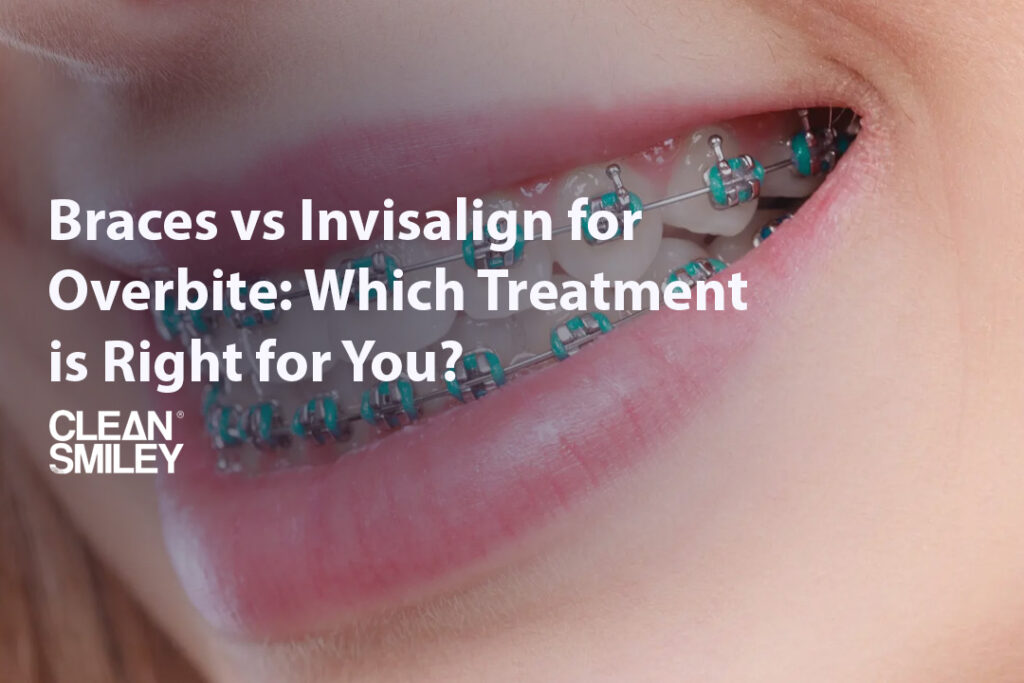
Braces fix an overbite by moving the front teeth up into the bone, letting the back teeth erupt slightly and levelling the curve of the lower arch, often with elastics that bring the lower teeth forward relative to the upper ones. Because brackets are bonded and the wires work around the clock, the dentist has close control over these vertical movements.
Braces for overbite usually combine several tools. Flexible archwires flatten a deep curve in the lower arch. Specially shaped wires, sometimes anchored to small titanium mini-screws (temporary anchorage devices), push the upper or lower incisors gently into the bone, a movement called intrusion. Small composite or metal stops, known as bite turbos or bite ramps, are often bonded behind the upper front teeth or onto the molars. They keep the back teeth slightly apart, which protects the lower brackets and gives the back teeth room to erupt as the bite opens.
Class II elastics are the other key part. Small rubber bands run from hooks on the upper canines to the lower molars and pull the lower teeth forward while holding the upper teeth back. Elastics only work when worn as instructed, often most of the day and night, and forgetting them is one of the most common reasons braces treatment runs longer than planned.
In growing children and teenagers, braces can be combined with functional appliances such as a Twin Block or a Herbst appliance, which hold the lower jaw forward and encourage it to grow into a better position. Extractions are occasionally part of a braces plan for overbite, usually when there is also crowding or a large overjet. Ceramic brackets work in the same way as metal ones and are less visible, although the wires still show.
Can Invisalign fix an overbite?
Yes, Invisalign can fix an overbite in many cases, particularly mild to moderate overbites caused mainly by tooth position. Modern aligner systems use attachments, bite ramps and elastics to make vertical movements that plain trays could not manage. Severe skeletal overbites are more difficult, and in those cases aligners are usually combined with other approaches or replaced by braces.
Invisalign for overbite works well when the plan is realistic about how teeth respond. Clear aligners are relatively good at pushing front teeth up into the bone and at tipping them forward, and both movements help open a deep bite. They are less efficient at making back teeth erupt. Clinical studies have found that the bite often opens less than the computer simulation shows, so plans usually build in some overcorrection, and extra sets of aligners (refinements) are common before the bite is finished.
Attachments and bite ramps
Attachments are small tooth-colored bumps of composite resin bonded to selected teeth. Each one gives the aligner a surface to push against, so the tray can grip the tooth and move it in a precise direction. For deep bites, attachments on the premolars help level the arch and anchor the movement of the front teeth. Precision bite ramps are small raised areas built into the inside of the upper aligners behind the incisors. The lower front teeth meet these ramps first, which keeps the back teeth slightly apart and gives them room to erupt as the bite opens.
Elastics with aligners
Elastics are used with aligners as well. Small cut-outs in the aligner edge, or buttons bonded to the teeth, act as hooks, and the rubber bands are worn in the same Class II direction as with braces. Many people starting aligner treatment do not expect elastics, but when the problem involves the relationship between the upper and lower teeth, some force between the two arches is usually needed.
Mandibular advancement for growing teens
For teenagers whose lower jaw is set back and still growing, Invisalign offers a version with mandibular advancement. Precision wings on the sides of the aligners guide the lower jaw forward every time the mouth closes, in a similar way to a functional appliance, while the aligners continue straightening the teeth. Timing matters, because the effect depends on growth that is still to come, and it is not used for adults whose jaws have finished growing.
Braces vs Invisalign for overbite: how do they compare?
Braces offer more direct control in complex and skeletal overbites, while Invisalign offers a discreet, removable option that works well for many dental overbites if you wear it consistently. Neither system wins in every case, and the comparison below focuses on the differences that matter for a deep bite rather than for straightening teeth in general.
| Factor | Braces | Invisalign and other clear aligners |
|---|---|---|
| Control of vertical tooth movement | High, forces act continuously | Good for pushing front teeth up, weaker for letting back teeth erupt |
| Severe or skeletal overbite | Usually preferred, can be combined with appliances, mini-screws or surgery | Possible in selected cases, often with limits |
| Growing teenagers | Can be combined with functional appliances | Mandibular advancement version for suitable growing patients |
| Elastics | Often needed | Often needed |
| How much depends on you | Mainly elastic wear and avoiding breakages | Aligners worn 20 to 22 hours a day, plus elastics |
| Visibility | Visible, ceramic brackets less so | Nearly invisible, attachments are tooth-colored |
| Eating | Hard and sticky foods avoided | Aligners removed for meals |
| Cleaning | Takes extra time around brackets and wires | Normal brushing and flossing with the trays out |
| Visits | Adjustments roughly every 4 to 8 weeks | New trays in stages, check-ups usually every 6 to 10 weeks |
Comfort is broadly similar. Both systems cause pressure and tenderness for a day or two after each wire change or new set of aligners, which is a sign that the teeth are moving. Brackets can rub the cheeks and lips at first, and aligner edges can feel sharp until they are smoothed. Material sensitivity is rare but worth raising: standard brackets and wires contain nickel, while aligners are plastic. If you have reacted to metals or dental materials before, mention it at the consultation, just as you would if you were wondering whether you could be allergic to a zirconia crown.
Distance matters if you are travelling for treatment. Braces need regular adjustments in person, so a plan started in Antalya usually needs a dentist or orthodontist near home for the visits in between. Aligners are delivered in stages and need fewer chairside visits, but attachments, refinements and progress checks still require some appointments. Ask how follow-up will work before you start, whichever system you choose.
Which option suits a mild, moderate or severe overbite?
Mild and moderate overbites caused by tooth position are usually suitable for either braces or clear aligners. Severe overbites, and especially skeletal ones, more often call for braces, growth-guiding appliances in teenagers or a combination of orthodontics and jaw surgery in adults. The table summarizes the usual starting points, and the final choice always follows an examination.
| Overbite type and severity | What it usually looks like | Usual options |
|---|---|---|
| Mild dental overbite | Overlap a little larger than normal, lower front teeth still clearly visible | Clear aligners or braces, often as part of straightening crowded teeth |
| Moderate dental overbite | About half or more of the lower front teeth hidden, early wear possible | Clear aligners with attachments, bite ramps and often elastics, or braces with bite turbos and elastics |
| Severe dental overbite | Lower front teeth almost or fully hidden, may touch the gum behind the upper teeth | Braces are often preferred, sometimes with mini-screws, aligners in selected cases |
| Skeletal overbite in a growing patient | Lower jaw set back, deep bite, often with a large overjet | Functional appliance with braces, or aligners with mandibular advancement |
| Skeletal overbite in an adult | Lower jaw set back, short lower face, bite does not open with tooth movement alone | Braces to camouflage the bite, or braces combined with jaw surgery |
Severity is judged from more than how the teeth look in the mirror. The amount of gum showing, the length of the lower face, the health of the gums and roots, existing restorations and how you feel about your profile all shape the plan. Two people with the same overlap can end up with different recommendations.
When are braces the safer choice, and when do aligners work well?
Braces are usually the safer choice when the overbite is severe, mainly skeletal or combined with other large problems, or when consistent aligner wear is unlikely. Clear aligners work well for mild to moderate dental overbites in people who will wear them as prescribed and who value being able to remove them for meals, cleaning and work.
Situations that favor braces
Braces tend to be recommended when one or more of the following applies:
- the lower front teeth bite into the gum behind the upper teeth
- the lower jaw is clearly set back and the plan relies on a fixed growth appliance or on surgery
- teeth need large root movements or rotations, or extraction spaces have to be closed alongside the bite correction
- the back teeth need to erupt a long way to open the bite
- wearing aligners for 20 to 22 hours a day is not realistic, for example for a younger teenager who often forgets
Where clear aligners fit well
Aligners are a strong option for adults and older teenagers with a mild to moderate dental overbite, for people whose teeth have shifted after earlier orthodontic treatment, and for those who want treatment to stay discreet at work. They also suit people who find it hard to clean around brackets, as long as the gums are healthy and stable before treatment starts.
Planned cosmetic work is another reason to settle the bite first. If you are considering zirconium crowns or veneers on the front teeth, opening a deep bite beforehand gives the dental technician space to make restorations of a natural length that are not overloaded every time you close. The same applies whether braces or aligners are used for that first step.
How is overbite correction in adults different from teens?
Overbite correction in adults relies on moving teeth, because the jaws have stopped growing, while in teenagers the growth that is still to come can be used to bring a set-back lower jaw forward. Adults can still have their bite corrected with braces or aligners, but a large skeletal difference may need surgery to correct fully.
Age itself is not a barrier. Teeth move at any age if the gums and bone are healthy, although adult tissue may respond a little more slowly. Adults are more likely to have crowns, fillings, implants, missing teeth or some gum recession, so a gum check and X-rays come first, and any active gum disease or decay is treated before tooth movement begins. Many adults choose aligners because they are discreet, and adults often find consistent wear easier to manage than younger teenagers do.
In teenagers the timing of treatment matters. Functional appliances and aligners with mandibular advancement are most effective during the growth spurt, which typically comes earlier in girls than in boys. Starting at the right stage can reduce the need for more complex treatment later, although growth is not fully predictable and the final position of the jaw is reviewed at the end of treatment.
When are jaw surgery or a specialist referral discussed?
Jaw surgery is discussed when an adult has a marked skeletal overbite, usually with a set-back lower jaw, and tooth movement alone would either fail to open the bite or leave the teeth in an unstable or unhealthy position. In this approach, called orthognathic surgery, braces first line up the teeth, an oral and maxillofacial surgeon then repositions the jaw, and braces finish the bite afterwards.
Most overbites never reach that point. A referral to a specialist orthodontist or a maxillofacial surgeon is also sensible when the jaw joint is painful or locks, when the face is noticeably asymmetric, or when the bite has been treated before and has returned. Clear aligners can sometimes be used in the orthodontic phases on either side of surgery, but braces remain the more common choice in surgical cases.
How long does Invisalign take for an overbite?
Invisalign typically takes about 6 to 12 months for a mild overbite and 12 to 24 months for a moderate one, including refinements. Severe overbites can take longer or may need braces instead. The total depends on how far the teeth have to move, how the bite responds and, above all, whether the aligners and elastics are worn for 20 to 22 hours a day.
| Situation | Typical treatment time (varies from person to person) |
|---|---|
| Mild dental overbite with aligners | About 6 to 12 months |
| Moderate dental overbite with aligners | About 12 to 24 months |
| Moderate to severe overbite with braces | About 18 to 24 months, sometimes longer |
| Growing teenager, appliance phase plus braces or aligners | Often 18 to 30 months in total |
| Adult treated with braces and jaw surgery | Often 18 to 36 months, including the orthodontic phases on both sides of surgery |
| Retention afterwards | Long term, usually night-time wear after the first months |
Braces for overbite take a similar amount of time in moderate cases, usually somewhere between one and a half and two years. The difference lies in what slows treatment down. With braces, delays usually come from broken brackets, missed appointments or elastics that are not worn. With aligners, the most common cause is wearing the trays too little, which lets the teeth fall behind the planned movement until the next set no longer fits well.
Refinements are a normal part of aligner treatment for a deep bite. After the first series, a new scan shows where the teeth are compared with the plan, and further aligners finish the detail. Planning for this from the start keeps expectations realistic, especially if you are travelling to Antalya and need to fit visits around work and flights.
How do you keep an overbite from coming back?
Retainers keep an overbite from coming back, and they are needed after both braces and aligners. Deep bites have a known tendency to relapse, so retention usually combines a thin wire bonded behind the front teeth with a removable clear retainer, worn full time at first and then at night for the long term.
Teeth sit in bone and gum fibers that need many months to adapt to their new position, and the bite keeps changing slowly throughout life. An upper removable retainer can include a small flat plate behind the incisors, so that the lower teeth meet it and the bite stays open. Fixed retainers are checked at every visit, because a loose bond can let a single tooth shift without you noticing.
How long to wear retainers is decided individually, but many orthodontists now advise night-time wear for as long as you want to keep the result. Bring your retainers to check-ups, replace them if they crack or stop fitting, and contact your dentist quickly if the bite starts to feel deeper again or the lower front teeth begin to disappear behind the upper ones.
Frequently Asked Questions
Can an overbite be corrected with braces on the upper teeth only?
Only in rare, very mild cases. An overbite is a problem with how the upper and lower teeth meet, so correcting it almost always involves both arches. Treating one arch alone can straighten that row of teeth while leaving the bite as deep as before, or even push it in the wrong direction. The same applies to aligners, which are normally made for both the upper and lower teeth.
Can a mild overbite be left untreated?
A mild overbite that causes no wear, no gum irritation and no concern about appearance can often simply be monitored. Regular check-ups let your dentist compare the front teeth over time and spot early chipping, flattening or gum changes. Treatment becomes more worthwhile if the overlap increases, the teeth start to wear, or you are planning crowns or veneers on the front teeth.
Will correcting an overbite change my profile?
Tooth movement alone usually changes the profile only slightly, mostly through small shifts in lip support. Larger changes come from guiding jaw growth in teenagers or from jaw surgery in adults, which can bring the chin forward and lengthen the lower face. Facial photographs and X-rays taken at the start help your dentist explain which kind of change is realistic for your bite.
Does overbite treatment hurt?
Most people feel pressure and tenderness rather than real pain. It is usually strongest for a day or two after braces are adjusted or a new set of aligners is started, and it fades as the teeth settle. Soft foods help during those days, and your dentist can suggest simple pain relief if needed. Sharp pain, a broken wire or a sore that does not heal should be checked.
Can crowns or veneers fix an overbite without orthodontics?
Crowns and veneers can change the shape and length of teeth, but they cannot move the teeth or jaws into a different bite. On a deep overbite, restorations may hide the problem at first while carrying heavy forces that increase the risk of chipping or debonding. In most cases the bite is corrected first, and cosmetic restorations are designed afterwards for the new position.
Can dental implants or a full-arch restoration correct an overbite?
Implants replace missing teeth and do not move natural teeth, so they cannot correct an overbite while your own teeth are still in place. If all the teeth in an arch are being replaced with a full-arch restoration, the new bite can be designed with a more normal overlap. When natural teeth remain, orthodontic treatment is the way to correct the bite.
Can I start overbite treatment in Antalya and continue it at home?
It is often possible, but it needs planning before you start. Aligner treatment usually suits travel better, because trays are supplied in stages and fewer chairside visits are needed. Braces require regular adjustments, so a local dentist or orthodontist normally takes part in the follow-up. Agree in advance how check-ups, refinements, lost attachments and retainers will be handled between visits.
Choosing between braces and Invisalign for an overbite is easier once you know whether your deep bite is dental, skeletal or both, and how severe it is. At Clean Smiley Turkey in Antalya, we start with X-rays, photographs and a 3D scan, then go through the options that fit your bite and your daily routine. See a dentist soon if your lower front teeth bite into the gum, your front teeth are visibly wearing or chipping, or your jaw clicks, aches or locks.
This article is for general information and does not replace a dental examination or personal medical advice.
Related Articles