Brushing alone cleans only about 60 percent of your tooth surfaces. The remaining 40 percent, the tight interproximal spaces between teeth where cavities and gum disease most frequently originate, can only be reached by dental floss. Despite being one of the simplest and most affordable tools in oral healthcare, flossing remains the most skipped step in daily hygiene routines worldwide.
The American Dental Association recommends flossing at least once per day as an essential complement to brushing, yet surveys consistently show that fewer than one in three adults floss daily. This guide covers everything you need to know about dental floss, from choosing the right type for your teeth to mastering the technique that actually removes plaque without damaging your gums.
What Is Dental Floss?
Dental floss is a thin filament, typically made from nylon (multifilament) or PTFE (monofilament), designed to slide between the contact points of adjacent teeth and clean the interproximal surfaces that a toothbrush cannot reach. The concept dates back to the early 19th century when a New Orleans dentist named Levi Spear Parmly first recommended silk thread for cleaning between teeth in 1819. Modern dental floss has evolved dramatically since then, with a wide range of materials, coatings, and formats engineered to suit different tooth spacing, dexterity levels, and prosthetic situations.
The fundamental purpose of flossing is mechanical plaque removal. The biofilm that accumulates between teeth contains the same bacterial species responsible for dental caries and periodontal disease, yet this biofilm is physically inaccessible to toothbrush bristles regardless of how advanced the brush is. When left undisturbed, interproximal plaque matures within 24 to 48 hours into a more organized, pathogenic community that produces acids attacking enamel and toxins triggering gum inflammation. Dental floss disrupts this biofilm at its most vulnerable stage, before it can cause measurable damage, making daily flossing one of the most cost-effective preventive measures in all of dentistry.
How To Use Dental Floss?
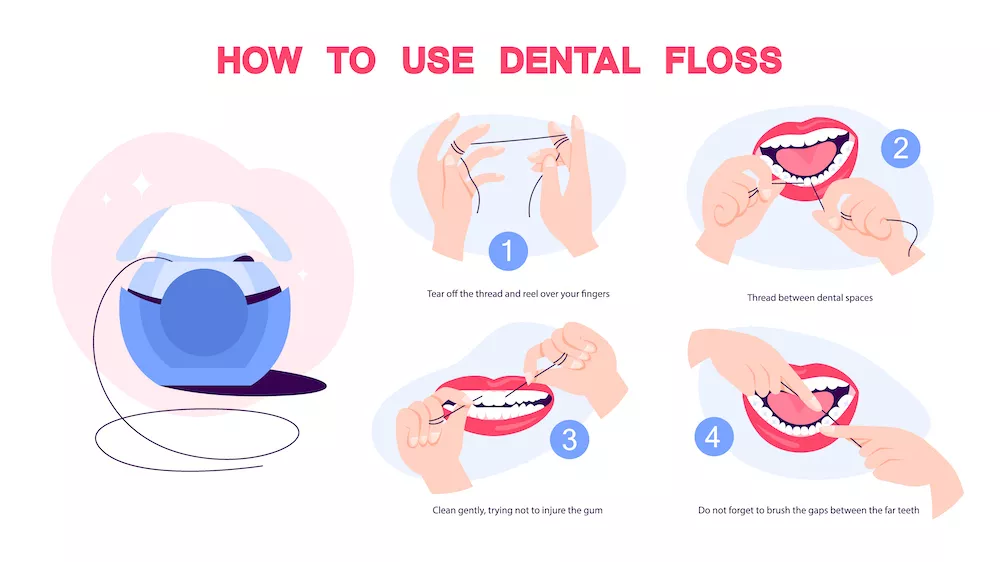
Using dental floss effectively requires more than simply pushing a string between your teeth. The correct technique follows a specific sequence designed to maximize plaque removal while protecting the delicate gum tissue.
Start by cutting approximately 45 to 50 centimeters of floss, enough to use a fresh section for each interproximal space. Wind the majority of the floss around the middle finger of one hand and a small amount around the middle finger of the other hand; the second finger acts as a spool to collect the used floss as you progress.
Pinch the floss between your thumbs and index fingers, leaving a taut working segment of roughly two to three centimeters between them. This short working length is critical; a longer span reduces control and increases the risk of the floss snapping forcefully into the gum.
Guide the floss gently between two teeth using a back-and-forth sawing motion to handle through the contact point. Once the floss passes through the contact, curve it into a “C” shape against one tooth surface and slide it gently beneath the gumline into the sulcus, the shallow groove where the gum meets the tooth.
Move the floss up and down along the tooth surface two to three times, hugging the tooth closely. Then curve the floss into a “C” against the adjacent tooth and repeat. Withdraw the floss by reversing the sawing motion through the contact point, advance to a clean section, and move to the next interproximal space. Work systematically from one side of the mouth to the other, including the back surface of the last molars, which is frequently neglected.
Why Is Flossing Non-Negotiable?
The interproximal surfaces of teeth are where the majority of dental disease begins. Cavities between teeth, known as interproximal caries, are among the most common findings on dental radiographs and frequently require restorative intervention ranging from simple composite fillings to Dental Crowns or even root canal treatment when detected late. Periodontal disease, the leading cause of tooth loss in adults, also initiates in the interproximal zone where undisturbed plaque matures into calculus and triggers chronic inflammatory destruction of the gum attachment and underlying bone.
A meta-analysis published in the Journal of Clinical Periodontology concluded that flossing combined with tooth brushing significantly reduces interproximal bleeding and gingivitis compared to brushing alone. The evidence is clear: brushing without flossing leaves the highest-risk surfaces of your teeth unprotected. For patients who have invested in restorative or aesthetic treatments such as Emax Veneers, Composite Bonding, or Dental Implants, flossing is not optional; it is the single most important daily habit for protecting those investments from secondary decay, peri-implant disease, and premature failure.
Choosing the Right Floss for Your Teeth
Not all dental floss is the same, and selecting the right type for your oral anatomy and any prosthetic work you may have dramatically affects both comfort and effectiveness. The following table summarizes the main categories:
| Floss Type | Material | Best For | Key Feature |
| Waxed nylon | Multifilament nylon with wax coating | Tight contacts, beginners | Slides easily between snug teeth |
| Unwaxed nylon | Multifilament nylon, no coating | Normal contacts | Thinner profile, more tactile feedback |
| PTFE (monofilament) | Single-strand polytetrafluoroethylene | Very tight contacts, rough restorations | Shred-resistant, ultra-smooth glide |
| Dental tape | Flat, broad nylon or PTFE | Wide spaces, bridges | Covers more surface area per pass |
| Super floss | Three-component (stiff end, spongy middle, regular floss) | Bridges, implants, orthodontic wires | Threads under fixed prosthetics |
| Floss picks | Pre-threaded plastic holders | On-the-go use, limited dexterity | Single-hand operation, less technique needed |
Patients with natural teeth and normal contact tightness can choose between waxed and unwaxed nylon based on personal preference. Those with very tight contacts or teeth that tend to shred standard floss should switch to PTFE monofilament products, which glide through the tightest spaces without fraying.
Super floss is indispensable for patients with dental bridges, implant-supported prostheses, or orthodontic appliances; its stiff threader end allows passage under fixed structures, and the spongy middle section effectively cleans the wide surfaces beneath pontics and around implant abutments. This is particularly important for patients with All on 4 or All on 6 restorations, where the prosthesis sits close to the gum and requires daily cleaning underneath to prevent peri-implant mucositis.
Mastering the Technique: The “C-Shape” Method
The “C-shape” is the single most important element of effective flossing technique. When the floss is curved around the tooth in a C configuration, it conforms to the convex surface of the tooth and reaches slightly beneath the gumline into the sulcus, the exact zone where pathogenic plaque accumulates. A flat, straight piece of floss snapped up and down between teeth misses the majority of the interproximal surface and traumatizes the papilla, the triangular point of gum tissue between teeth, without removing meaningful amounts of plaque.
The correct motion is vertical, not horizontal. Once the floss is curved into a C against one tooth surface, move it gently up and down, allowing the floss to slide just one to two millimeters beneath the visible gum margin. You should feel slight resistance but no pain. Repeat on the adjacent tooth before withdrawing. The entire mouth, typically 28 to 30 interproximal contacts, should take no more than two to three minutes once the technique becomes habitual. If you find the C-shape difficult to achieve with traditional floss, a floss holder or pick can simplify the process, though it offers slightly less adaptability than finger-guided flossing.
Common Flossing Mistakes to Avoid
Even patients who floss regularly may be undermining their efforts through technique errors that reduce effectiveness or cause tissue damage.
Snapping the Floss
The most common and most damaging mistake is forcing the floss through tight contacts with a sudden snap. When the floss breaks through the contact point with uncontrolled force, it slams into the gum papilla, causing bruising, cutting, and chronic trauma that leads to papilla recession over time. The correct approach is a gentle, controlled sawing motion that eases the floss through the contact gradually. If your contacts are so tight that even careful sawing is difficult, switching to PTFE monofilament floss eliminates the problem; its ultra-smooth surface glides through the tightest spaces without requiring excessive force.
Missing the Gumline
Many patients floss only between the visible portions of their teeth, popping the floss in and out without ever reaching the sulcus. This approach removes food debris but leaves the most critical zone, the subgingival plaque along the gum margin, completely undisturbed. The purpose of flossing is not primarily to remove food; it is to disrupt bacterial biofilm in the sulcus where periodontal disease begins. If your floss does not gently slide beneath the gumline on every tooth surface, you are missing the most important part of the exercise.
Reusing Dirty Sections
Using the same section of floss for multiple interproximal spaces simply transfers bacteria and plaque from one site to another. Each time you move to a new space, advance the floss so that a clean section makes contact with the tooth. This is why the recommended starting length is 45 to 50 centimeters; it provides enough clean material for every contact in the mouth. Economy with dental floss is false economy; a single roll contains enough material for months of use and costs less than a single dental filling.
Water Flossers vs. Traditional Floss
Water flossers have surged in popularity over the past decade, and many patients wonder whether they can replace traditional dental floss entirely. The answer depends on your specific oral situation.
How Water Flossers Work
A water flosser delivers a pressurized stream of water through a narrow nozzle directed at the interproximal spaces and along the gumline. The pulsating water jet dislodges food particles, disrupts loosely attached biofilm, and flushes bacteria from periodontal pockets and prosthetic structures.
Clinical studies have shown that water flossers are particularly effective for patients with orthodontic braces, dental implants, bridges, and crown restorations where traditional floss navigation is difficult. A study published in the Journal of Clinical Dentistry found that water flossing combined with manual tooth brushing was significantly more effective at reducing bleeding and gingivitis than brushing combined with string floss in patients with mild to moderate periodontal disease.
However, for patients with healthy gums and natural teeth, traditional dental floss remains the most effective tool for mechanically scraping adherent biofilm from interproximal surfaces. The physical contact of floss against the tooth provides a level of plaque removal that a water jet alone cannot fully replicate in tight, healthy contacts.
The ideal approach for most patients is to use both: traditional floss or super floss for mechanical biofilm disruption, and a water flosser for flushing debris from around complex restorations, implant abutments, and deep pockets. Patients with Hollywood Smile restorations, multiple Emax Veneers, or implant-supported bridges benefit enormously from incorporating a water flosser into their daily routine alongside traditional flossing.

FAQ
Should I floss before or after brushing?
Research favors flossing before brushing. A study in the Journal of Periodontology found that flossing first loosens interproximal plaque and debris, allowing the fluoride from toothpaste to penetrate more effectively into the cleaned interproximal spaces during subsequent brushing. The sequence of floss first, brush second, and rinse last delivers measurably higher fluoride retention in the areas most vulnerable to decay.
Why do my gums bleed when I floss?
Bleeding during flossing is almost always a sign of gingivitis, inflammation caused by plaque accumulation in areas that have not been cleaned regularly. Paradoxically, the solution is more flossing, not less. When you begin flossing consistently, the inflammation subsides as the bacterial load decreases, and bleeding typically resolves within one to two weeks. If bleeding persists beyond two weeks of daily flossing, consult your dentist for a periodontal evaluation; persistent bleeding may indicate a deeper infection that requires professional scaling and root planing. Teeth Whitening and other aesthetic procedures should always be preceded by an assessment of gum health, and resolving bleeding through consistent flossing is a fundamental first step.
Is it okay to floss only once a week?
Weekly flossing is far better than never flossing, but it is insufficient for preventing interproximal disease. Bacterial biofilm begins reorganizing within hours of disruption and reaches pathogenic maturity within 24 to 48 hours. Flossing once a week leaves the interproximal surfaces unprotected for the vast majority of the time, allowing plaque to mature, calcify, and initiate both caries and gum inflammation. Daily flossing, ideally once every 24 hours, is the minimum frequency recommended by every major dental organization worldwide.
Can I reuse my piece of dental floss?
No. Used dental floss cannot be effectively cleaned or sterilized and should be discarded after a single use. Reusing floss reintroduces bacteria into the mouth and can also introduce frayed or weakened filaments that are more likely to shred and become lodged between teeth. Dental floss is inexpensive and designed for single use; a fresh piece for each session is a non-negotiable hygiene standard.
What if the floss gets stuck between my teeth?
If dental floss becomes trapped between teeth, do not force it out by pulling sharply upward or downward, as this can damage the gum papilla or dislodge a restoration. Instead, try to release the floss by gently pulling it horizontally from one side, sliding it out through the contact rather than snapping it vertically.
If you cannot remove it, cut one end and pull the floss through sideways. Floss that consistently gets stuck or shreds in the same location may indicate a rough restoration margin, an overhanging filling, or a cavity at the contact point, all of which should be evaluated by your dentist. Rough restoration margins can often be smoothed during a routine check-up, or the restoration may need replacement with a properly contoured Composite Bonding or ceramic restoration.
Conclusion
Dental floss is the simplest, most affordable, and most underutilized tool in preventive dentistry. It reaches the 40 percent of tooth surfaces that your toothbrush cannot, disrupts the bacterial biofilm responsible for cavities and gum disease, and protects every restoration in your mouth from secondary decay and peri-implant complications. Whether you choose waxed nylon, PTFE monofilament, super floss, or a water flosser, the critical factor is consistency: once a day, every day, with correct C-shape technique and a fresh section of floss for every interproximal space.
Your smile is an investment, whether it consists of natural teeth, Dental Crowns, Emax Veneers, or a full All on 4 restoration, and dental floss is the insurance policy that protects that investment every single day.
To ensure your oral hygiene routine is supporting your dental health and your restorations, or to explore complete treatment options in the heart of the Mediterranean, contact Clean Smiley Turkey. Our expert team in Antalya combines world-class restorative and preventive dentistry with an unforgettable patient experience. Request your free quote today.