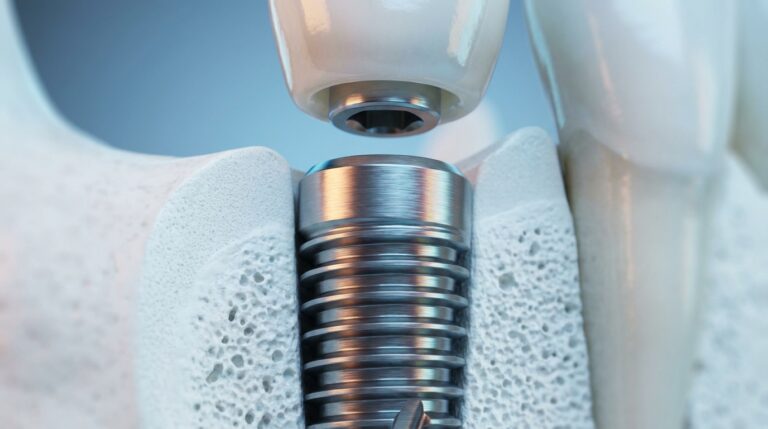
If you have already looked at the patient experience side of domestic implants, this piece is the other half of the conversation. Here we step back from individual stories and look at the products themselves — the actual Turkish-made implant brands, what is inside them, what their certifications look like, and where they sit next to premium European systems. The aim is to help you read a treatment plan with a domestic implant on it and understand what you are agreeing to.
This is a clinic perspective, not a marketing one. We use both domestic and premium implants in our chair every week, and we have written the same kind of review notes about premium brands in other pieces. The job of this one is to demystify what “Turkish implant” actually means as a product.
What “domestic implant” means in a Turkish dental clinic
A domestic implant — sometimes called a Turkish implant or a yerli implant — is an implant system designed and manufactured by a company based in Turkey. The titanium is the same medical-grade titanium used worldwide. The geometry, surface treatment and prosthetic components are designed in Turkey, certified for sale through the relevant authorities, and produced in domestic facilities.
The honest, blunt distinction is this: the implant body itself — the screw that goes into your jawbone — is similar across most reputable brands worldwide. The differences live in the surface chemistry, the abutment connection design, and the length of published clinical data behind each system.
The main Turkish implant brands you will see in clinic
Six names come up most often on real treatment plans across Turkey. Knowing them by sight makes a treatment quote easier to read.
Implance
Ankara-based, with FDA registration and a track record of academic research collaborations. Often used as a mid-tier option for routine restorative cases. The connection design supports multiple abutment types, which gives the restorative side of treatment flexibility. Patients who research domestic options online almost always come across Implance first.
Mode Medikal (Mode Implant)
One of the most widely placed domestic systems in Turkey. Strong in standard single-tooth and multi-tooth cases. The product line includes several connection geometries, which means a clinic stocking Mode can handle most routine implant scenarios without switching brands.
Nucleoss
Made from pure titanium with a surface treatment focused on osseointegration efficiency. Used in cases that need flexibility in abutment selection, including some restorative-heavy scenarios.
NTA Implant
A growing brand with a focus on accessible pricing and standard restorative scenarios. Used in clinics that want a reliable domestic option for routine cases.
Bilimplant and DTI
Established Turkish manufacturers with product lines covering the standard single-implant and multi-implant cases. Smaller volume than Implance or Mode but established enough to appear regularly on treatment plans.
Certifications: what to look for on a domestic implant
The serious question with any implant — domestic or premium — is not “what country is it from?” but “what certifications does it carry?” The shorthand list of what to look for:
- CE marking. Required for sale in Europe, and the baseline for any implant used in Turkey.
- FDA registration. Not all domestic brands have it; Implance is one that does. FDA registration adds a layer of regulatory confidence.
- ISO 13485. Quality management standard for medical devices. Most established Turkish manufacturers carry it.
- Published clinical data. Independent studies, ideally in peer-reviewed journals, with multi-year follow-up. This is where premium brands still lead by years of accumulated evidence.
- Implant passport at delivery. The clinic should be able to give you a card or paper with the implant brand, model, lot number and placement date. This is your documentation if you need maintenance abroad later.
A treatment plan that names the brand and model on paper is the minimum standard. Phrases like “premium implant” or “European-quality implant” without a specific name are not a product — they are marketing.
The product comparison breaks down into four practical buckets.
Material. Both domestic and premium brands use medical-grade titanium (Grade 4 or Grade 5/Ti-6Al-4V). At the metal level, there is no meaningful difference.
Surface treatment. This is where premium brands have a measurable edge. Surface treatments like Straumann’s SLActive or Nobel’s TiUnite have decades of published data on osseointegration speed and behaviour in compromised bone. Domestic brands use established surface treatments (acid-etched, sandblasted, mixed) that work well in healthy bone but have less long-published evidence at twenty-year horizons.
Connection design. Premium systems often have proprietary connection geometries with restorative components that are widely stocked in dental labs around the world. Domestic systems have their own connection designs, well supported within Turkey but with smaller restorative component networks abroad.
Clinical track record. Premium brands have published data going back decades. Domestic brands have shorter published tracks — measured in years rather than decades — but the data that does exist for the established Turkish brands shows predictable performance in routine cases.
Where domestic implants are a strong product choice
Based on what we see in our chair and on follow-up imaging at one and three years, domestic implants perform predictably in these scenarios:
- Single-tooth replacement in the molar or premolar zones, with healthy bone volume — see our general overview of dental implants in Turkey for the wider context.
- Multi-tooth bridges in patients with stable periodontal health.
- Routine full-arch All-on-4 or All-on-6 cases where the bone supports planned anchor positions.
- Patients with no clenching or grinding habits, or with a night guard already in place.
- Patients who plan to receive their long-term maintenance in Turkey or in regions with strong Turkish brand distribution.
Equally honestly, here are the situations where we recommend a premium European brand over a domestic one:
- Aesthetic front-tooth cases where soft-tissue stability over years matters more than cost.
- Compromised bone where surface-treatment behaviour at the bone interface needs the longest published track record.
- Immediate-load full-arch cases where the implant goes into function within hours of placement.
- Patients who live in countries with weaker access to Turkish-brand restorative components and want easy local maintenance.
- Patients with a history of failed implants, where reducing variables in the next attempt matters more than reducing cost.
The point is not that one tier is universally better. The point is that the product choice should match the case. A surgeon who recommends the same brand for every patient is not reading the cases.
Pricing logic: why domestic implants cost less
The cost difference between domestic and premium implants is not about quality cuts in the product. It comes from three places: lower R&D amortisation across a smaller product history, lower manufacturing overhead in Turkey, and shorter distribution chains. The titanium is the same. The factories meet the same regulatory standards. The savings sit on the business side, not the surgical one.
What this means in practice is that for a routine implant in healthy bone, the domestic option is a fair-value product. For a complex or aesthetic case, the premium option’s added cost buys decades of published evidence and a wider service map.
What to ask before agreeing to a domestic implant
If a treatment plan in front of you mentions a domestic implant, these are the practical questions to ask the clinic before signing anything:
- What is the exact brand and model of the implant being placed?
- What surface treatment does it use?
- What certifications does it carry — CE, FDA, ISO 13485?
- What is the warranty offered by the manufacturer, and what is the warranty offered by the clinic on the placement?
- Will I receive an implant passport with the lot number after surgery?
- If I live abroad, how widely available are this brand’s restorative components in my country?
- Why is this brand the right choice for my specific case rather than a premium option?
A clinic that answers these in writing, with the brand and model named, is giving you a real product. A clinic that gets vague at any of these questions is a warning sign.
What patients tell us about choosing a domestic brand in retrospect
The most useful retrospective feedback we hear, two and three years after placement, falls into a few honest categories. Patients who chose domestic implants for routine cases — single molars, standard bridges, well-planned full-arch — almost universally say the decision was the right one for them. They do not think about the implant in daily life. They are not in a different maintenance schedule than premium-brand patients.
Patients who occasionally express regret about a domestic choice tend to be in two groups: aesthetic front-tooth cases where the gum line over the implant matured differently than expected, and patients who moved countries after surgery and found local maintenance more complicated than they wanted. Neither group says the implant failed. They say they would have made a different brand choice for their specific scenario if they had known.
This is exactly why the brand choice deserves a real conversation, not a default. For a personal opinion on whether a domestic implant fits your case, you can send us your imaging through the contact form or WhatsApp and we will write a second-opinion plan.
Frequently asked questions about domestic implant products
What is a domestic implant?
A domestic implant is a dental implant system designed and manufactured by a company based in Turkey. The titanium is medical-grade and matches the material used worldwide. The differences from premium European brands are in surface treatment, connection geometry and the length of published clinical data behind each system.
Are domestic implant brands certified internationally?
The established Turkish brands carry CE marking (required for European sale) and ISO 13485 (medical device quality standard). Some, such as Implance, also carry FDA registration. Certifications should be visible on the clinic’s documentation for the specific brand being placed.
Which Turkish implant brand is the most common?
Implance, Mode Medikal and Nucleoss appear most often on treatment plans in Turkey. Each has a track record in routine restorative cases. Smaller-volume brands like NTA Implant, Bilimplant and DTI also appear in specific case scenarios.
Is a domestic implant the same quality as a Straumann or Nobel?
For routine cases in healthy bone, a well-placed domestic implant performs predictably and similarly to entry-level premium implants. The premium brands maintain a measurable edge in surface treatment evidence over decades and in global restorative component availability — both of which matter most in complex, aesthetic or international maintenance scenarios.
Will I receive documentation for my domestic implant?
Yes — a serious clinic provides an implant passport or written record with the brand, model, lot number and placement date. This is your documentation if you need any maintenance, restorative work or imaging interpretation years later. Ask for it as part of the treatment plan, not as an extra.
Can I switch from a domestic to a premium implant during my treatment?
Yes, before surgery. The brand decision is part of the written treatment plan and is finalised after reviewing your imaging together. If you change your mind during the consultation, the plan is updated with the new brand and revised cost. After placement, switching is much more complex because the prosthetic components are brand-specific.
How we frame the brand choice in our clinic
Our standard is to present at least two brand options for every implant case — one domestic and one premium where both are clinically reasonable. We explain where each sits on cost, evidence, aesthetics and global service. We write the choice down. You decide with the information in front of you.
If you want a second opinion on a treatment plan that mentions a specific implant brand — Turkish or imported — you can reach us through the contact form or WhatsApp. We will look at the plan, the imaging, and write back with a clinical view in plain language.