When you look in the mirror, that tiny chip on your tooth, the gap between two teeth, or that stubborn stain bothering you might catch your eye. Most people hesitate to take action, thinking that correcting these flaws requires cutting down their teeth or enduring months of treatment.
However, thanks to “Composite Bonding,” the hidden hero of modern aesthetic dentistry, it is possible to achieve the smile of your dreams, sometimes even during a lunch break. As Clean Smiley Dental Clinic, we explain in detail how this artistic touch, performed without touching the tooth tissue, creates that mesmerizing difference between “before and after.”
What is Composite Bonding? (The 60-Minute Smile Upgrade)
Composite Bonding is where dentistry meets the art of sculpture. In this procedure, there is no waiting for a laboratory process; the dentist applies a high-aesthetic composite resin material, which matches the natural color of the tooth exactly, in layers onto the tooth and shapes it by hand craftsmanship. This procedure, performed without the need to cut or reduce the tooth and usually without even requiring anesthesia, is completed within approximately 60 minutes. The result is an instant transformation achieved without compromising naturalness.
Before and After Gallery: Case Studies by Problem Type
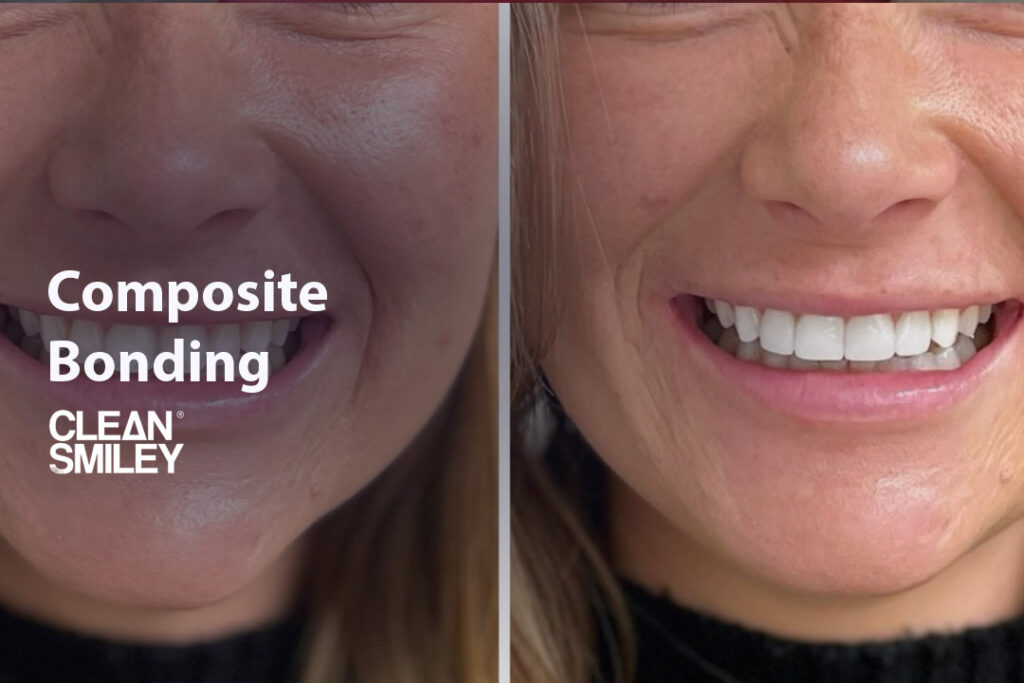
The most impressive aspect of bonding treatment is its ability to provide solutions to a wide variety of aesthetic problems in a single session. Let’s examine how those insecure smiles in “Before” photos turn into confident expressions in “After” shots.
Fixing Chipped Edges: Restoring Symmetry
Fractures at the tips of teeth caused by accidents, or edges that have become jagged due to wear over time, cause the smile to look old and neglected. In the bonding application, these irregular edges are completed with special filling materials, restoring the tooth to its original form. What you see in the “After” is a smooth and symmetrical tooth line, as if that break never happened.
Closing the “Diastema” (Gaps Between Teeth)
Gaps between the front teeth, known as “diastema,” may be a characteristic feature for many, but for some, they are an aesthetic concern. For our patients who do not want to undergo brace treatment, bonding is the fastest way to close these gaps. By making additions to the side surfaces of the teeth, the teeth are visually widened, and the gap is completely closed. The result is a unified, continuous smile line.
Masking Discoloration & Stains
Some tooth stains are resistant to whitening procedures or stem from the internal structure of the tooth. In these cases, bonding is used as a masking agent. A thin composite layer applied to the front surface of the tooth completely covers the underlying dark color or stain, ensuring the tooth looks bright, white, and compatible with the other teeth.
Reshaping “Peg Laterals” (Small Teeth)
Genetically, some people’s lateral incisors may be smaller than normal or pointed (wedge-shaped). This condition, called “Peg lateral,” creates disproportion in the smile. With bonding, additions are made to these small teeth to make their size and volume compatible with other teeth, thus eliminating the feeling of “incompleteness” in the smile.
The Procedure: From “Before” to “After” in One Visit
The bonding process moves very dynamically and quickly since there is no laboratory waiting time. The change between the moment you sit in the chair and the moment you get up is dizzying.
Step 1: Color Matching & Mock-up
The success of the procedure lies in choosing the right color. Your dentist analyzes the tone, translucency, and brightness of your natural tooth using special shade guides. If necessary, before the procedure, they place the composite material on your tooth without applying any adhesive (mock-up) to show you how the result will look.
Step 2: Etching and Layering
Once the color is approved, the tooth surface is cleaned and microscopically roughened (etching) to prepare it for the filling to hold. Then, a “bonding agent” is applied, and the artistic part begins. The dentist processes the paste-like composite onto the tooth layer by layer, hardens each layer with a special light, and gives the tooth its final form.
Step 3: Polishing and Bite Check
When the shaping is finished, the surface of the tooth is polished with special disks and rubbers to resemble natural enamel texture. This stage is critical to prevent stain retention and ensure it feels smooth to your tongue. Finally, a bite check is performed, and any high spots are corrected.
The “First 48 Hours” Reality: What Nobody Tells You
Although your new smile looks great, the first two days after the procedure are an adjustment period, and it is extremely normal to experience certain sensations.
Why Your Teeth Might Feel “Thick” or “Rough”
Your tongue is the most sensitive organ in the mouth and notices a change even as thin as a strand of hair. The material added to your teeth may feel thick or different to your tongue at first. Additionally, your gums might be slightly sensitive due to the isolation during the procedure. It usually takes a few days for your brain to get used to this new texture and accept it as “your own tooth.”
The “High Bite” Sensation
You may not fully feel your biting pattern while under the effect of anesthesia. If, after the numbness wears off, you feel that only the bonded tooth is touching when you close your teeth, or if there is a “high point” while chewing, you must visit our clinic. This is a simple procedure that can be corrected in minutes, but if neglected, it can lead to pain or fracture of the filling.
Longevity & Maintenance: Keeping the “After” Look
The lifespan of the bonding procedure is between 5 to 7 years on average, but the most important factor determining this period is your maintenance habits.
The Staining Timeline
Composite materials do not have as much stain resistance as porcelain. Consumption of coffee, tea, red wine, and cigarettes can lead to discoloration at the edges of the fillings over time. However, the good news is that these discolorations can be easily removed with a professional polishing procedure performed during annual routine checks, restoring the bonding to its first-day brilliance.
How to Prevent “Edge Chipping”
You should avoid biting hard objects with your front teeth. Nail biting, chewing on pens, tearing tape, or cracking nuts with front teeth can cause the bonding material to chip at the tips. You should use your teeth as jewels, not as tools.
Composite Bonding vs. Veneers: Which “After” Do You Want?
If you want a more permanent, color-stable, and much more dramatic whiteness, Porcelain Veneers might be the right option for you. However, if you do not want your teeth to be cut, and are looking for a more economical procedure that finishes in a single session and can be repaired or completely reversed if needed, Composite Bonding is an excellent choice.
Cost Analysis: Investment vs. Value
Composite Bonding is a much more cost-effective solution compared to porcelain veneers or zirconium crowns. Prices vary depending on the number of teeth to be treated, the complexity of the case (e.g., is it just a chipped tip or a full surface coverage?), and the quality of the material used. In Turkey and at our clinic, this procedure is offered at world-class quality, well below European and UK prices.
To give a general idea, a single tooth bonding procedure can range on average between £100 and £250 (or the current exchange rate equivalent).
Note: Prices are for informational purposes and may vary according to the condition of the case. Please consult your doctor or our clinic for exact pricing information and a treatment plan.
Conclusion: Is Bonding Right for Your Smile?
If small flaws in your smile cause you to cover your mouth in photos, Composite Bonding could be the “magic touch” you’ve been waiting for. In just one hour, you can transform into the best version of yourself without damaging your teeth.
As Clean Smiley Dental Clinic, we are here to take you from your “before” state to your dream “after.” You can contact us for a free examination and a personalized treatment plan.