Last updated: October 23, 2026
Horseshoe denture is the everyday name for an upper denture shaped like a U, which sits on the gums where the teeth used to be and leaves the roof of the mouth open. Because it covers much less of the palate, it holds on with weaker suction than a full upper denture.
Horseshoe denture designs are used for complete and partial upper dentures, with or without implants, and the right choice depends on your gums, remaining teeth and saliva. At Clean Smiley Turkey in Antalya, a palateless design is planned only after the ridge shape, the bite and any natural teeth have been checked.
What is a horseshoe denture?
A horseshoe denture is an upper denture with a U-shaped base that covers the gum ridge and a narrow band behind the front teeth but leaves the centre of the palate uncovered. It is also called a palateless, roofless or U-shaped denture, and it can replace all of the upper teeth or only some of them.
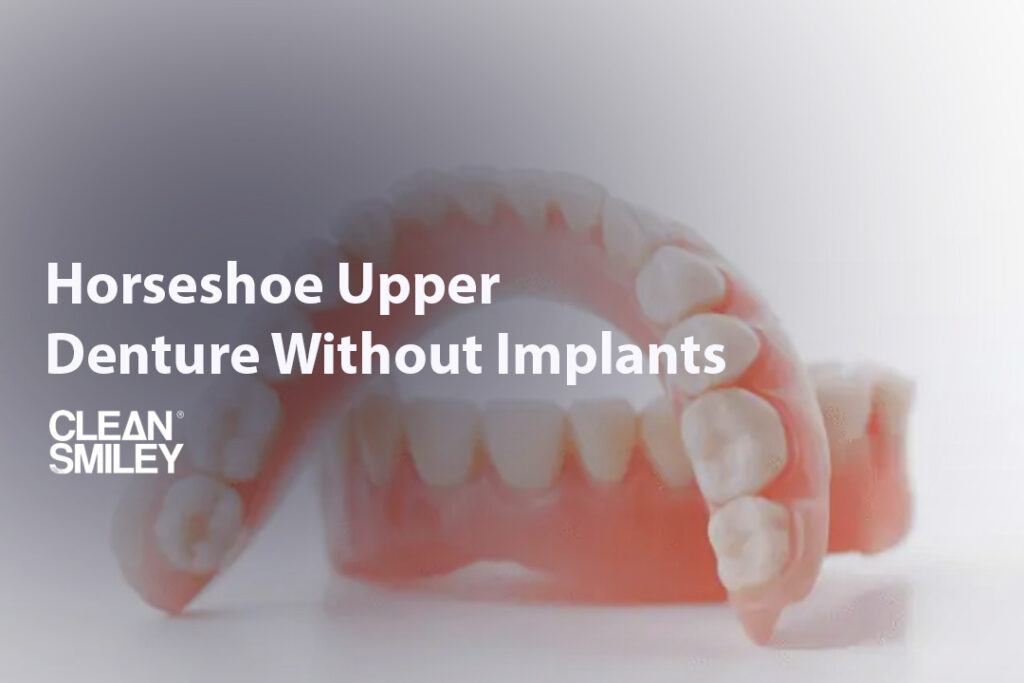
There are three common forms. A complete horseshoe denture replaces every upper tooth and relies on the gums alone. A horseshoe partial denture replaces some teeth and is held by clasps on the remaining natural teeth, often with a thin metal framework. An implant-supported version clips onto implants or is screwed to them. Lower dentures already have a horseshoe shape because of the tongue, so the term almost always refers to the upper jaw.
Why is the palate left open on a horseshoe upper denture?
The palate is left open for comfort. Uncovering it lets you feel the temperature and texture of food, gives the tongue more room for clear speech, makes the denture feel less bulky and avoids the sensitive area at the back of the mouth that can trigger gagging in some people.
The gag reflex is often the first reason. A full upper denture has to reach the line where the hard palate meets the soft palate to seal, and in people with a sensitive reflex that contact alone can cause retching. A U-shaped base stops well short of it.
Taste and speech follow. Most taste buds sit on the tongue, but the palate senses heat, cold and texture, and those signals shape how flavour is perceived, so food under a full plate can seem flatter. Sounds such as “t”, “s” and “sh” depend on the tongue meeting the front of the palate, and a thick plate changes that contact. A horseshoe base still needs a short adjustment period, but there is less acrylic in the way.
Horseshoe denture vs full denture: what is the difference?
The main difference between a horseshoe denture and a full denture is how much of the palate is covered. A full upper denture covers the whole roof of the mouth and gains strong suction from it. A horseshoe denture covers only the arch, so it feels lighter and more natural but holds on less firmly unless teeth or implants support it.
| Feature | Horseshoe (palateless) upper denture | Full palate upper denture |
|---|---|---|
| Palate coverage | Gum ridge and a narrow band behind the front teeth | The entire hard palate |
| Suction and retention | Weaker, because the sealing surface is much smaller | Stronger, with a seal along the back of the palate |
| Gag reflex | Rarely triggered | Can be triggered in sensitive people |
| Taste, temperature and texture | Closer to natural | Often dulled, especially for hot drinks |
| Speech | More room for the tongue | Thicker plate can affect “s” and “t” at first |
| Strength of the base | Narrow U can flex, so reinforcement is often added | Wide plate is rigid and spreads chewing forces |
| Most suitable for | Partials, implant-supported dentures, selected complete dentures | Most complete upper dentures without implants |
The comparison explains why many dentists still recommend a full palate for a complete upper denture without implants, and why the horseshoe shape becomes the norm once teeth or implants can hold the denture. The palatal denture user reviews show how full palate dentures feel in daily life.
Can you get horseshoe dentures without implants?
Yes, horseshoe dentures without implants can be made, but how well they work depends on the type. A horseshoe partial denture held by healthy natural teeth is a routine and stable option. A complete horseshoe denture with no teeth or implants is possible in selected cases, but it is usually looser than a full palate denture.
For partials, the U-shaped connector is a standard design: clasps grip the remaining teeth and small rests carry biting forces. For complete dentures, the denture may feel very comfortable yet lift during chewing, especially with sticky or hard foods. Some people accept that trade-off because the open palate matters more to them, so the decision deserves a clear conversation before anything is made.
What affects horseshoe denture stability?
Horseshoe denture stability depends on the shape and height of the gum ridges, the firmness of the tissue over them, how much saliva you produce, the seal around the edges and the forces coming from the lower jaw. Without the palate, each of those factors carries more weight than it would in a full denture.
A full upper denture stays in through a thin film of saliva and a sealed border that creates a small vacuum. The wide palate generates much of that suction, and the seal along its back edge keeps air out. Remove the palate and the seal has to run along the inner edge of the U, where the tongue keeps moving.
Tall, firm ridges resist sideways movement, while flat ridges after years of bone loss offer little grip. A dry mouth, which can follow certain medications or health conditions, weakens suction. A full set of natural lower teeth also bites harder than a lower denture and can tip an upper denture loose.
Who is a good candidate for a palateless denture?
A good candidate for a palateless denture usually has well-formed upper ridges or several healthy upper teeth to anchor a partial, normal saliva flow and a clear reason to keep the palate open, such as a strong gag reflex or a bony lump in the palate (torus palatinus). Implant support widens the group of suitable candidates considerably.
Very flat ridges, a dry mouth, loose or flabby tissue over the front ridge and heavy biting from natural lower teeth make a complete horseshoe denture harder to wear. At Clean Smiley Turkey, the assessment covers the ridges and soft tissue, any remaining teeth, saliva, the bite, X-rays and, if implants are being considered, a 3D scan of the bone. The outcome may be a horseshoe design, a slimmer full palate denture or an implant-supported option.
How is a horseshoe upper denture kept in place without implants?
A horseshoe upper denture without implants stays in place through careful design rather than one single feature. Accurate impressions, well-shaped borders, a seal along the inner edge, a balanced bite and, for partials, clasps on the remaining teeth all add retention. Denture adhesive can help a little when the dentist advises it.
- Detailed impressions that record the ridges and the muscle movements at the borders, so the edges seal snugly.
- Borders extended as far as the cheeks and lips allow, adding surface area.
- A carefully shaped inner edge on the U, sometimes with a slightly raised seal line.
- A balanced bite, so chewing presses the denture onto the ridge instead of tipping it.
- For partials, clasps and rests on the remaining teeth, with a metal or flexible base.
In some mouths, a few healthy roots can be root-treated, shortened to gum level and kept under the denture to add support and preserve bone. Adhesive has a place too, but only a small amount as your dentist or the product instructions advise. If you keep needing more of it, the fit has changed and the denture needs a check or a reline.
What changes when implants support a horseshoe denture?
When implants support a horseshoe denture, retention comes from attachments on the implants instead of suction, so the palate can stay open without the denture lifting during chewing or speech. The two main options are a removable overdenture that clips onto implants and a fixed bridge screwed to them.
A removable overdenture snaps onto small stud attachments, often called stud attachments, or onto a bar, and comes out for cleaning. Because upper bone is softer than lower bone, a palateless upper overdenture usually needs four or more implants. The guide on snap-in dentures versus fixed implant teeth explains the daily differences.
A fixed full-arch bridge stays in the mouth and never covers the palate. All-on-4 dental implants use four implants, other plans use six, and the choice depends on bone volume and bite forces, as the comparison of All-on-4 vs All-on-6 explains.
| Feature | Without implants | Implant-retained removable | Fixed implant bridge |
|---|---|---|---|
| What holds it in | Suction, border seal, clasps on teeth for partials | Stud or bar attachments | Screws into the implants |
| Stability when chewing | Variable, may lift with sticky food | Firm | Fixed |
| Surgery | None | Implant placement | Implant placement |
| Typical timeline | Several appointments over a few weeks | Healing period of several months | Temporary teeth first, final bridge after healing |
| Jaw bone | Ridge keeps shrinking slowly | Implants can help slow bone loss | Implants can help slow bone loss |
| Main limit | Depends heavily on anatomy and saliva | Attachment parts wear and are replaced | Needs enough bone and good general health |
Bone volume, sinus position, gum health, smoking and some medical conditions all affect implant planning. If implants are not possible now, a well-made denture remains a valid choice and implants can be considered later.
How long does it take to get used to a horseshoe denture?
Most people need a few weeks to get used to a horseshoe denture. Speech usually settles within one to two weeks, eating with confidence often takes three to four weeks, and sore spots in the first days are common and normally eased with small adjustments by the dentist.
Reading aloud speeds up speech adaptation. Start with soft food cut small, chew on both sides at once and avoid biting with the front teeth, which levers an upper denture away from the palate. Adjustment visits are part of the process, so if you are travelling for treatment, plan a check before flying home. The removable denture user reviews give a sense of how the first weeks feel.
How do you care for a horseshoe denture and when does it need relining?
Caring for a horseshoe denture means rinsing it after meals, brushing it daily with a soft brush and a non-abrasive cleaner, leaving it out overnight in water or a soaking solution and brushing your gums and any natural teeth. Relining is needed when the gums shrink and the fit loosens, often after one to two years.
Regular toothpaste can scratch acrylic, and hot water can warp it. Handle the denture over a towel or a basin of water. A reline adds new material to the fitting surface and restores the seal, which matters more for a horseshoe base because a smaller base has less margin when the ridge changes. Avoid home reline kits and household glue.
| Sign | What it may mean | What to do |
|---|---|---|
| Sore spot lasting more than a few days | Pressure point or rough edge | Book an adjustment |
| Looser fit or more adhesive needed | Ridge has shrunk or seal has worn | Ask about a reline or new attachment parts |
| Crack, chip or loose denture tooth | Base fatigue, often at the front of the U | Stop wearing it if sharp and arrange a repair |
| Rocking or clicking while chewing | Uneven bite or changed fit | Have the bite and fit checked |
| Red or white patch or ulcer not healed in two weeks | Irritation or a condition needing a closer look | See a dentist or doctor promptly |
Frequently Asked Questions
Can my current full upper denture be cut into a horseshoe shape?
Usually not. A complete denture is designed to gain suction from the palate, so cutting that area away often leaves it loose and weakens the base. A horseshoe design works better when it is planned from the start, with new impressions and borders shaped for the smaller base. A partial denture can sometimes be modified after a dentist has assessed it.
Is a horseshoe denture the same as a flexible denture?
No. “Horseshoe” describes the shape of the base, while “flexible” describes the material. A horseshoe denture can be made from rigid acrylic, acrylic with a metal framework or a flexible nylon-type material. Flexible bases are used mostly for partials, while complete dentures generally use a rigid base that spreads chewing forces and is easier to reline.
Do I need denture adhesive every day with a horseshoe denture?
Not necessarily. Partial horseshoe dentures held by clasps rarely need adhesive. Complete horseshoe dentures without implants sometimes benefit from a small amount, for example when eating out. Use only what your dentist suggests and remove it fully each day. Needing more and more adhesive means the fit has changed.
Can I sleep with my horseshoe denture in?
Most dentists advise taking a removable denture out at night. A few hours without pressure lowers the risk of soreness and fungal infection under the base, and overnight soaking keeps it clean. If you have a reason to wear it at night, ask your dentist. A fixed implant bridge stays in and is cleaned in the mouth.
How long does a horseshoe denture last?
A removable denture is often relined every one to two years and replaced after several years, commonly between five and ten, depending on wear, care and changes in the gums. A horseshoe base may need closer monitoring because it has less surface to make up for fit changes. Implant attachment parts wear sooner and are replaced during routine maintenance.
Can a horseshoe denture be made during one trip to Antalya?
A conventional denture involves impressions, bite records, a try-in and fitting, and with careful planning these steps can often fit into one stay. Adjustments in the first weeks are normal, so check your clinic’s written aftercare policy on follow-up visits and remote reviews. Implant-supported dentures need a healing period, which usually means two trips.
A horseshoe denture can make an upper denture feel lighter and more natural, as long as the plan is honest about stability and matched to your mouth. At Clean Smiley Turkey in Antalya, the choice between a palateless partial, a complete horseshoe denture, a full palate denture or an implant-supported option is made after an examination and a scan. If your denture is loose, sore or cracked, or a sore spot has not healed within two weeks, see a dentist wherever you are.
This article is for general information and does not replace a dental examination or personal medical advice.
Related Articles