Last updated: October 9, 2026
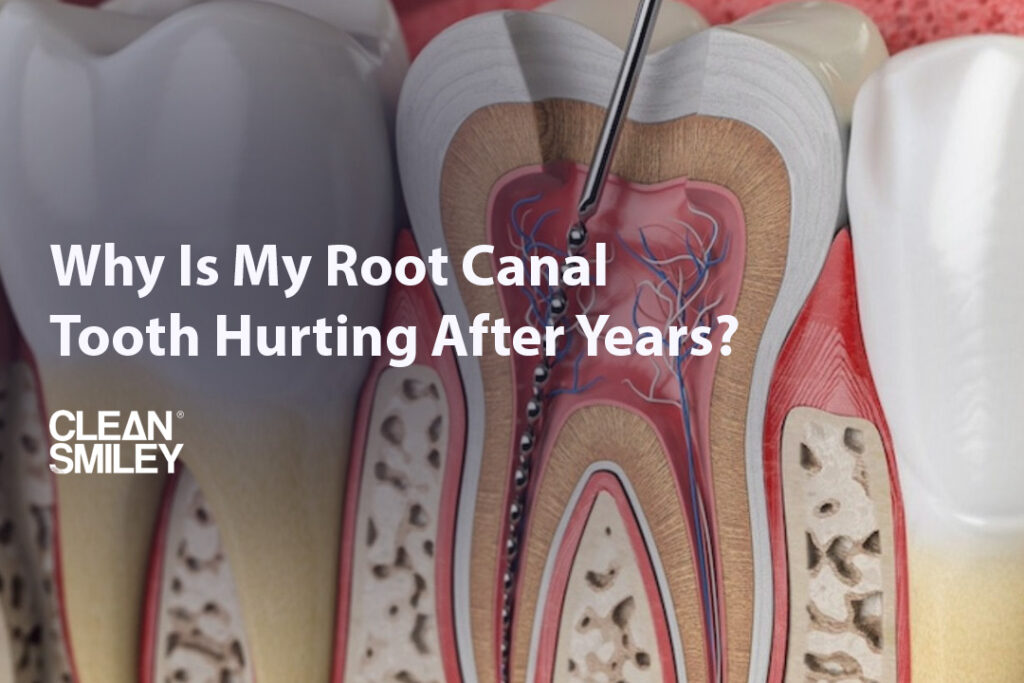
Root canal pain years later usually means bacteria have found a new way into an old root canal, or the tooth or its root has cracked. The nerve inside the tooth is gone, but the ligament, bone and gum around the root still have nerves, so they can ache, throb or hurt when you bite.
Root canal pain years later is not something to wait out, but it does not automatically mean the tooth is lost. At Clean Smiley Turkey in Antalya, an old root canal tooth that hurts again is checked with new X-rays, a bite test and a gum check first, because the cause decides whether retreatment, surgery or a new crown makes sense.
Can a root canal tooth hurt years later?
Yes, a root canal tooth can hurt years later, even though its nerve was removed. The pain comes from the tissues around the root: the periodontal ligament that holds the tooth in its socket, the jawbone and the gum. When bacteria or a crack irritate these tissues, the tooth can feel sore, tender to bite on or simply “wrong”.
Studies commonly report that roughly 85 to 95 percent of root canal treated teeth stay healthy for many years, depending on how success is measured. Still, no dental treatment lasts forever, so a root canal tooth hurting again after a long quiet period is a known problem rather than a mystery. Sometimes it never hurts at all, and the problem shows up only as a shadow at the root tip on a routine X-ray.
Why is my root canal tooth hurting years later?
When a root canal tooth is hurting years later, the cause is usually one of five problems: new decay or a leaking crown, a canal that was missed or not fully cleaned, a crack in the tooth or root, a seal inside the canals that has broken down, or a tooth that never got a proper crown. Each one lets bacteria back in or weakens the tooth.
New decay or a leaking crown
A root canal treated tooth can still get cavities. Over the years, the edge where a crown or filling meets the tooth can open up, and bacteria seep through the gap toward the root filling (coronal leakage). With no living nerve, there is no early toothache to warn you, so decay grows quietly under the crown until the bone around the root reacts.
A missed or partly cleaned canal
A canal that was missed or not fully cleaned can hold bacteria for years. Upper molars commonly have a fourth, very narrow canal (known as MB2) that is easy to overlook without magnification. Bacteria left there can stay under control for a long time, then flare up when the balance shifts, for example during an illness.
A crack in the tooth or root
A crack can develop years after a root canal and is one of the hardest causes to spot. Treated teeth are weaker, mainly because decay and the access opening removed tooth structure, so heavy chewing or grinding can split them, especially without a crown. Root cracks rarely show clearly on a standard X-ray, so the dentist looks for clues such as a single deep, narrow gum pocket next to the tooth.
A worn-out seal inside the canals
The canals are filled with a rubber-like material called gutta-percha and a sealer cement. Over many years the sealer can shrink or wash out in places, leaving small voids where bacteria settle and keep the tissue at the root tip inflamed. Older materials are more prone to this.
No crown, a lost filling or a crown placed late
Back teeth that had a root canal usually need a crown. When a crown was never placed, was delayed for months, or has come loose, bacteria and chewing forces both get easier access to the tooth. A temporary filling left in place for a long time is a classic weak point.

Could the pain come from something other than the root canal?
Yes, pain that seems to come from an old root canal tooth sometimes starts somewhere else. Common look-alikes are a bite that hits too hard because of clenching or grinding, gum disease around the tooth, a sinus infection pressing on the upper back teeth, and decay or a crack in a neighboring tooth. A careful exam separates these from a true failure.
Grinding overloads the ligament around the root, so the tooth feels bruised in the morning. Gum disease can open a deep pocket next to a sound root canal. Upper molars sit just below the sinus floor, which is why congestion from a cold or sinus tooth pain can feel exactly like a failing root canal, often across several upper teeth at once.
What are the symptoms of a failed root canal?
The most common failed root canal symptoms are pain when biting or chewing, tenderness in the gum over the root, a small pimple on the gum that drains, swelling, and a bad or salty taste. The tooth may also feel slightly “high” when you close your mouth. Symptoms often come and go, which makes them easy to dismiss.
- Pain when biting, chewing or tapping on the tooth
- A dull ache or throbbing, sometimes worse at night
- A small bump or “gum boil” near the root that may leak fluid
- Swelling of the gum, or of the face and jaw in more advanced cases
- No symptoms at all, with the problem found only on an X-ray
A draining bump works much like an abscess on the gum: an infection that has found a way out. Pain often eases while it drains, but the infection stays active. When it spreads into the jaw, the warning signs change, and they are covered in our guide to symptoms of jaw infection after root canal.
Root canal tooth hurting after 2 years: what does the timing tell you?
Timing gives the dentist a useful clue, but it never replaces an exam. A root canal tooth hurting after 2 years more often points to a problem left over from the first treatment, such as a missed canal or a crown placed late. Pain that starts 10 or more years later is more often linked to new decay, a leaking crown or a crack.
| Time since the root canal | What is usual or likely | What to do |
|---|---|---|
| First few days | Tenderness when biting, a mild ache | Follow your dentist’s aftercare advice |
| One to three weeks | Discomfort should be clearly fading | Call your dentist if it stays the same or worsens |
| Months to about 2 years | Infection that never fully healed, a missed canal, leakage through a temporary filling | Exam with an X-ray |
| 2 to 10 years | Leaking crown edge, new decay, worn seal inside the canals | Exam with an X-ray, compared with older images |
| 10 years or more | New decay, a crack or root fracture, gum disease | Exam with an X-ray, sometimes a 3D scan |
How does a dentist find out why an old root canal hurts?
A dentist finds the cause by combining an X-ray with a few simple chair-side tests. The X-ray shows the root filling, the bone at the root tip and any decay under the crown. Tapping and bite tests show which tooth is sore, and measuring the gum around the root can reveal a crack or gum disease.
- Questions about when the pain started and what triggers it
- A close look at the crown edges and the gum around the tooth
- Tapping and a bite test on each cusp
- Gum pocket measurements all the way around the root
- Cold tests on neighboring teeth to confirm their nerves are healthy
- A periapical X-ray, plus a cone beam CT (CBCT) 3D scan when the flat image is not enough
At Clean Smiley Turkey, this assessment comes before any treatment plan is discussed. For patients traveling to Antalya, sending recent X-rays ahead of the visit helps plan enough time for the right treatment.
What happens during root canal retreatment?
Root canal retreatment means opening the tooth again, removing the old filling material from the canals, cleaning and disinfecting them more thoroughly, and sealing them again. The goal is to remove the bacteria behind the new problem while keeping your natural tooth. It is usually the first option when the tooth is still solid and the root is not cracked.
The tooth is numbed with local anesthetic, and access is made through the crown, or the crown is removed if it is leaking. The old gutta-percha is taken out, the dentist searches for missed canals, ideally under a microscope, and the canals are cleaned and sealed again, sometimes over two visits.
Studies generally report that most retreated teeth heal well, although the odds are somewhat lower than for a first root canal. A new crown or a well-sealed filling soon afterwards is part of the treatment, because it stops bacteria from leaking back in.
When is root-end surgery or extraction the better choice?
Root-end surgery (apicoectomy) fits when the infection sits at the root tip but the tooth cannot easily be reopened from the top, for example under a new crown or a long post. Extraction becomes the realistic choice when the root is cracked lengthwise, too little tooth is left, or bone loss is severe. The dentist weighs these options after the exam.
In an apicoectomy, the root tip and the inflamed tissue around it are removed through a small opening in the gum, and the root end is sealed with a biocompatible material. Recovery usually involves a few days of swelling.
| Option | What it does | When it usually fits | What to expect |
|---|---|---|---|
| Root canal retreatment | Cleans and reseals the canals from the top | Solid tooth, no root crack | One or two visits, then a new crown or filling |
| Apicoectomy | Removes the root tip and infected tissue through the gum | Retreatment not possible or not enough | Short procedure under local anesthetic |
| Extraction and replacement | Removes the tooth, then an implant or bridge fills the gap | Cracked root, too little tooth, severe bone loss | Healing time before the replacement is finished |
When should you see a dentist promptly?
See a dentist promptly if an old root canal tooth causes swelling, fever, pus, a bad taste that keeps coming back, or pain that spreads to the jaw, ear or neck. Swelling that makes it hard to swallow, breathe or open your mouth, or that reaches the eye or neck, needs emergency care the same day.
| Sign | What it may mean | How soon |
|---|---|---|
| Trouble swallowing or breathing, swelling near the eye or neck | A serious spreading infection | Emergency care now |
| Swelling of the face or jaw | Infection spreading beyond the tooth | Same day |
| Fever or feeling unwell with tooth pain | Infection affecting the whole body | Same day |
| Pus, a gum boil or a salty taste | Active infection draining from the root | Within a few days |
| Biting pain that comes and goes | Early failure, a crack or a bite problem | Within one to two weeks |
| A shadow on an X-ray but no symptoms | Possible chronic infection | As your dentist advises |
Squeezing a gum boil at home can push bacteria deeper, as explained in our article on whether popping a gum abscess can be dangerous. Pain relief your dentist or pharmacist recommends can ease symptoms for a while, but it cannot reach bacteria sealed inside the root.
How can you protect a root canal tooth for the long term?
You can protect a root canal tooth by keeping it sealed and strong: a well-fitting crown on back teeth, regular check-ups with X-rays, careful cleaning around the crown edge, and a night guard if you grind. Each step targets one of the two main threats, bacteria leaking in from the top or cracks from heavy biting.
- Have a permanent crown or filling placed soon after a root canal, not months later
- Get a chipped, loose or leaking crown checked early
- Avoid using the tooth to crack nuts, ice or hard sweets
- Keep your X-rays and records, especially if you had treatment abroad
If you are not sure whether your old root canal tooth was ever properly covered, our page on dental crowns explains how a crown protects a weakened tooth.
Frequently Asked Questions
Can an old root canal tooth be infected without any pain?
Yes. Because the tooth has no nerve, a chronic infection at the root tip can stay silent for years and is often found by chance on a routine X-ray. It still slowly affects the bone, so the dentist will usually suggest treatment or close monitoring, depending on its size and whether it is changing.
Does root canal retreatment hurt more than the first root canal?
Usually not. The tooth is numbed with local anesthetic, and because the nerve is already gone, the procedure is often more comfortable than people expect. Some soreness for a few days afterwards is common, especially if the tissue around the root was already inflamed. Pain relief your dentist recommends usually keeps it manageable.
How long does a retreated root canal tooth last?
There is no fixed number. Many retreated teeth stay healthy for years, but it depends on how much tooth is left, whether there is a crack, how well the new crown seals, and how the tooth is looked after. Regular check-ups with X-rays let the dentist confirm that the bone at the root tip is healing.
Can flying make a root canal tooth hurt?
It can. Pressure changes during a flight can trigger pain in a tooth that already has inflamed tissue at the root tip or a gap under a filling, which dentists call barodontalgia. If an old root canal tooth has started aching, it makes sense to have it checked before a long flight rather than after the trip.
Will a root canal tooth that hurts on and off heal by itself?
It is unlikely. Pain that comes and goes is typical of a chronic problem, such as a low-grade infection or a small crack, and quiet periods do not mean the cause has gone. Each flare-up can mean more bone loss around the root, and only an exam with an X-ray shows what is happening.
Does dental insurance cover root canal retreatment?
Coverage varies between plans and countries, and some plans have rules about retreating the same tooth within a set period. Check your policy wording, ask your insurer in writing, and ask the clinic for a written treatment plan and copies of your X-rays to submit with a claim. If the first treatment was recent, also check your clinic’s written aftercare policy.
An old root canal tooth that starts hurting is asking for a fresh look, not a quick fix. At Clean Smiley Turkey in Antalya, we start with an exam and X-rays, explain what is causing the pain and which options make sense for that tooth, and only then plan treatment. If you notice swelling, fever, pus or pain that spreads, see a dentist promptly, wherever you are.
This article is for general information and does not replace a dental examination or personal medical advice.
Related Articles